
In many Indian homes, especially where borewell water is the main source, this is not a rare situation. It’s happening in the background every single day.
That’s why choosing a water treatment system is not just about water quality. It’s about understanding how your home’s entire water system behaves and how to keep it working efficiently over time.
Contents
- 1 What is a Water Softener?
- 2 Why Do You Need a Water Softener?
- 3 Step-by-Step Guide on How to Choose the Best Water Softener For Your Home
- 3.1 Step 1: Start With Your Water Source
- 3.2 Step 2: Look at How Your Home Uses Water
- 3.3 Step 3: Understand the Type of System
- 3.4 Step 4: Check Installation Practicality
- 3.5 Step 5: Think About Maintenance, Not Just Purchase
- 3.6 Step 6: Focus on System-Level Impact
- 3.7 Step 7: Align With Real Indian Conditions
- 4 What is Hard Water?
- 5 Why Water Softener is Important?
- 6 Types of Water Softeners for Houses Available in 2025
- 7 Top 5 Best Water Softener for Houses in India in 2025
- 8 Closing Thoughts
- 9 FAQs
What is a Water Softener?
Before choosing anything, it helps to understand what you are actually trying to control.
Hard water mainly contains calcium and magnesium. These minerals enter your home through groundwater and travel across every pipeline, appliance, and outlet.
The problem is not their presence. It is their harmful behavior.
When water is heated or pressure changes inside pipes, these minerals start settling on surfaces. Over time, this becomes scale.
A home water softener is designed to change this behavior.
Different systems approach this differently:
- Some remove minerals from water
- Others change how these minerals act inside the system
Traditional systems use ion exchange. They replace hardness-causing minerals with sodium and require salt-based regeneration.
Modern electronic systems, often used as a water softener for residential homes, work by altering mineral crystallization. Instead of sticking to surfaces, minerals stay inactive in water and pass through the system.
This distinction is important because the goal is not always removal. In many homes, it is about preventing buildup.
Why Do You Need a Water Softener?
Most homeowners don’t think about water quality until something starts going wrong. But hard water rarely shows up as a sudden failure. It appears as small, repeated inefficiencies.
You might notice:
- The geyser taking longer to heat
- White stains returning even after cleaning
- Soap not lathering properly
- Appliances needing servicing more often
All of the above mentioned problems are connected to one root, which is hard water.
● Inside the plumbing system
Mineral deposits begin narrowing pipelines. Flow continues, but pressure and distribution start changing. Over time, this affects how water reaches different parts of the house.
● Inside appliances
Heating elements in geysers and washing machines get coated with scale. This layer reduces heat transfer, forcing the system to consume more energy.
● In daily usage
More detergent is used. More rinsing is required. Cleaning becomes repetitive instead of effective.
● On surfaces
Tiles, taps, and glass panels start holding stains that regular cleaning cannot fully remove.
● On your Skin and hair
Hard water leaves behind a mineral residue that prevents proper rinsing of soap and shampoo. This can lead to an itchy scalp, increased hair fall, and even skin irritation or infections over time. In many cases, it’s not the products but the water itself affecting skin and hair health.
This is why installing a hard water softener for home is less about convenience and more about preventing long-term issues.
Step-by-Step Guide on How to Choose the Best Water Softener For Your Home
Choosing the right system is not about picking a product. It is about understanding how water moves through your home.
Step 1: Start With Your Water Source
Everything begins here.
If your home depends on borewell water, hardness levels are usually higher due to mineral-rich underground formations.
Municipal water may vary. Tanker water is often inconsistent.
Knowing your source gives you a baseline. It tells you how aggressive the scaling tendency might be.
Step 2: Look at How Your Home Uses Water
Every household has a different usage pattern.
Think in terms of:
- Number of bathrooms
- Kitchen and washing load
- Simultaneous usage points
- External usage like gardening
Many people look for the best water softener for home based only on size or capacity.
But in reality, flow behavior matters more than volume. A system should align with how water moves, not just how much is used.
Step 3: Understand the Type of System
This is where clarity becomes important. Different systems handle hard water differently, and the long-term impact depends on how they interact with your plumbing and usage patterns.
There are four commonly seen approaches in residential setups:
1) Salt-Based Systems
These systems remove hardness minerals by replacing calcium and magnesium with sodium.
They operate in cycles and require:
- Regular salt refilling
- Regeneration cycles
- Water discharge during cleaning
They are widely used where hardness removal is the primary goal, but they come with ongoing maintenance and water usage.
2) Resin-Based Systems
This is the core mechanism used in salt-based setups. Resin beads capture hardness minerals during water flow and release sodium in exchange. Over time, the resin gets saturated and needs regeneration. This means:
- System performance depends on timely regeneration
- Efficiency reduces if maintenance is irregular
- Long-term operation involves recurring inputs
3) Magnetic Systems
These systems use magnetic fields applied externally to pipelines to influence mineral behavior.
They:
- Do not remove minerals
- Attempt to reduce scale formation
- Require minimal installation effort
Their performance can vary depending on water composition, pipe material, and flow conditions.
4) Electronic Systems
These systems work on breaking down the minerals into micron size and changing the mineral behavior within the flow using controlled electronic signals.
They:
- Do not remove calcium and magnesium
- Break down larger mineral structures into smaller particles
- Reduce their tendency to stick and form scale
- Work without salt, chemicals, or regeneration cycles
In many residential environments where continuous water usage, limited maintenance access, and borewell dependency are common, systems that manage scale without adding operational load tend to integrate more smoothly into daily use.
If your focus is reducing scale formation, lowering maintenance, and maintaining system efficiency over time, electronic systems often align better with residential infrastructure realities.
Step 4: Check Installation Practicality
Many decisions fail at this stage. Ask simple questions:
- Where does water enter your home
- Is there space for installation?
- Can the system integrate without major plumbing changes?
In existing homes, retrofitting should be simple. Systems that connect directly to pipelines without structural changes are easier to implement and maintain.
In many residential setups, especially where plumbing access is limited or already built, solutions like DIGIGO E-Soft water softener for homes are preferred because they can be installed directly on the main water line without breaking walls or altering the pipeline layout. This allows the system to start working across the house without disrupting daily usage.
Step 5: Think About Maintenance, Not Just Purchase
Every system works well on day one. The difference appears over time.
Consider:
- Does it need regular manual intervention?
- Are there consumables involved?
- Will you need frequent servicing?
A system that performs consistently with minimal attention often proves more practical in the long run.
Step 6: Focus on System-Level Impact
This is where most buyers miss the bigger picture. Instead of asking “Will this improve water quality?”, ask:
- Will this reduce scale inside my geyser?
- Will my appliances run more efficiently?
- Will cleaning frequency reduce?
- Will pipeline performance remain stable?
The best Water softener for house use is the one that improves how your entire system behaves, not just how water feels at one outlet.
Step 7: Align With Real Indian Conditions
Water systems in Indian homes do not operate under ideal conditions.
- Borewell usage is increasing
- Water supply is not always consistent
- Power conditions vary
- Maintenance access is limited
The solution you choose should adapt to these realities.
Systems like E-SOFT Water Softener for Homes are often considered in such environments because they work within existing plumbing setups and focus on reducing scale without adding operational complexity.
What is Hard Water?
Hard water is a common problem in households as a majority of houses are supplied with hard water. Hard water is raw water that contains impure substances like magnesium and ions that are harmful for you to use in the long run. These impure substances will result in various skin problems, and hair problems as well and they will reduce the work life of appliances by developing scales on corrosion on the surfaces.
Moreover, your hair can become harsh and there is a severe chance of going bald. Hard water causes several skin problems, it will make your skin dry as well. Many people become allergic to hard water if used for the long term. Plumbing costs also increase as hard water causes cloaking and choking in the pipes.
Why Water Softener is Important?
It is important to install a Water Softener System in your homes to save yourself from hard water as a water softener system is reliable in removing harmful substances like magnesium and ions. It can easily make the hard water soft and sufficient enough for use.
Moreover, water softener systems are like a one-time investment that will provide you with several benefits in the long run. It will help you increase your appliance’s work life by providing the proper water type that will maintain them, will not allow scales to develop, and prevent corrosion as well. Soft water will also nourish your hair and make your skin glow and soft as well.
The evolution of the water softener systems started during the 18th and 19th centuries. Scottish Engineer Thomas Clark was recognized for the discovery of lime’s ability to soften the water in 1748. After that many companies launched their water softener system in the market the soften the hard water available, and new generations of water softeners were introduced.
The hard water has gotten its hard nature from the particles like magnesium and calcium. To soften the water these particles are needed to be removed. To check if the water in your house is hard or not, add a little soap to it and if the water turns out to be soapy it’ll be soft water, and if not then it will be hard water. It is so because soap is easily mixed with soft water.
There are various types of water softener systems available in the market. The Types of water softeners available in 2025 are as mentioned below:-
Types of Water Softeners for Houses Available in 2025
- Salt-based ion exchange systems
- Salt-free water conditioners
- Dual-tank water softeners
- Magnetic water softeners
- Reverse osmosis systems
Salt-Based Ion Exchange System
A salt-based water softener typically works by drawing heavy minerals in the water, like calcium and magnesium, into a resin within the softener and exchanging them for sodium (salt).
Salt-Free Water Conditioners
A salt-free water conditioner is a water treatment system that crystallizes magnesium and calcium minerals prevalent in hard water. These micro-crystals are unable to attach to pipes and water heaters in the form of scale. Water conditioners do not remove hardness minerals.
Dual-Tank Water Softeners
Dual-tank water softener systems have 2 tanks in them. They have 2 resins present in them rather than 1 resin that helps them provide a continuous flow of soft water, without stopping the supply of soft water. This ensures that you have a continuous supply of water, even during regeneration.
Magnetic Water Softener Systems
Magnetic water treatment (also known as anti-scale magnetic treatment or AMT) is a method of supposedly reducing the effects of hard water by passing it through a magnetic field as a non-chemical alternative to water softening. Magnetic water treatment is regarded as unproven and unscientific.
Reverse Osmosis Systems
An RO system can soften water. However, constantly filtering hard water wears out the water purifier more quickly. Using an RO water system wastes a lot of water, so getting a water softener is a more economical solution if tackling water hardness is your top priority.
Top 5 Best Water Softener for Houses in India in 2025
Digigo E-Soft 5th Generation Water Softener
Digigo E-Soft is the number 1 Water Softener for Home in the market. It is the World’s first 5th generation Water Softener System. It converts water electronically rather than using any chemicals or salts. Moreover, it does not waste any water in the process of softening the water, unlike other water softener systems.
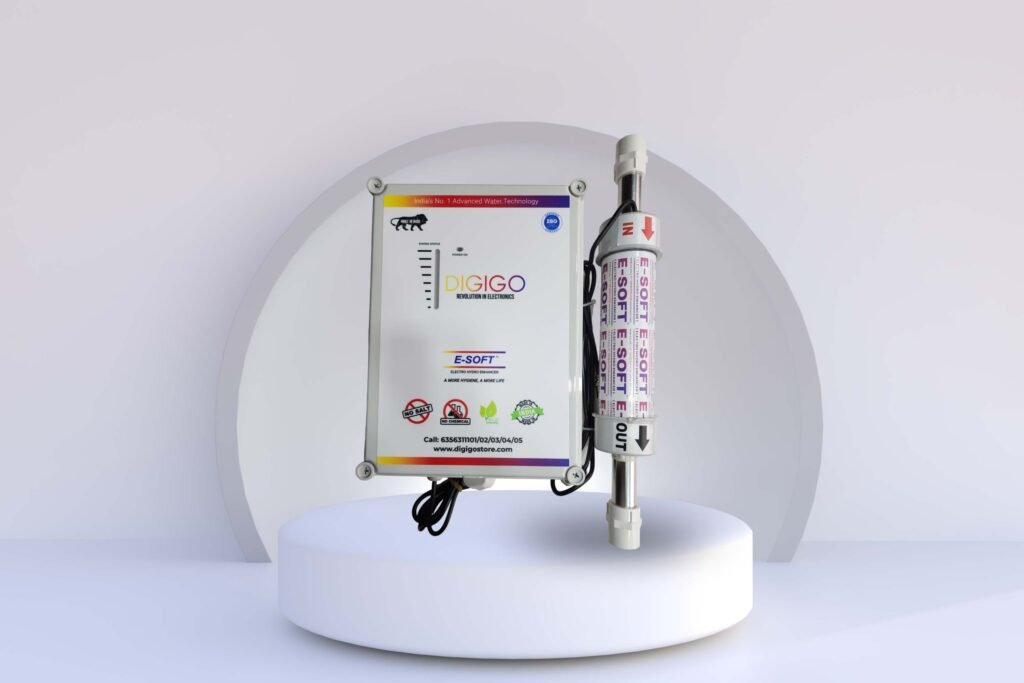
It gives you a work life of 30 years and it does not require any regular maintenance, even monthly or yearly maintenance. It softens water fully without any trace of hard water. It is eco-friendly and the best part is that it is 100% Made In India. It is the best hard water softener for home in 2025.
KENT Water Softener
KENT is constantly innovating and providing solutions to protect people from harmful diseases. Driven by the purpose of offering good health to one and all, KENT is, without a doubt, the best guardian of your family’s health and lets you drink pure, breathe pure, eat pure & live pure. KENT is a very recognized brand in Water Softener Systems. With several benefits and features, KENT is constantly working to establish itself better in the market.
3M Water Softeners
3M™ Fully Automatic Water Softener is available in two series namely SFT & WTS. It uses ion exchange technology for treating and softening hard water. It comes with a programmable multi-port valve thereby avoiding any manual intervention for its daily operation. Regeneration time can be set once and then the regeneration happens automatically while you are asleep.
ZeroB Water Softener
ZeroB offers advanced and uniquely designed water softeners for homes that convert hard water into soft water. Our water softeners use non-electric automatic regeneration technology along with an ion exchange process that helps you get rid of that manual and time-consuming regeneration process.
Tata Swach Water Softener
Tata Swach Automatic Water Softener has been granted a place in the top 5 water softener systems in 2025. It has many pros such as no boiling required, zero water wastage, and chemical usage.
We would recommend you go for Digigo E-Soft, with various benefits it is budget-friendly as well. The service is also good and they respond pretty well. So what do you want more? Check out Digigo E-Soft NOW!!!
Closing Thoughts
Hard water is not a visible problem in the beginning. It builds slowly inside pipelines, appliances, and systems until performance starts dropping.
By the time it becomes noticeable, the impact is already spread across multiple parts of the home.
Choosing a water softener for residential use is not about reacting to damage. It is about preventing it.
When mineral behavior is managed early:
- Appliances last longer
- Energy usage stays controlled
- Maintenance reduces
- Systems remain stable
The decision is not about choosing a device. It is about choosing how your home’s water system will behave over time.
FAQs
1. How can I identify hard water in my home?
Look for signs like white scaling on taps, reduced soap lather, frequent appliance issues, stains on bathroom surfaces, sticky skin even after bath, and heavy hairfall. Borewell-dependent homes are more likely to experience this.
2. What makes a residential water softener effective?
Effectiveness depends on how well the system manages mineral behavior, integrates with plumbing, and reduces long-term scaling without increasing maintenance burden.
3. Is removing minerals always necessary?
Not always. In many cases, preventing minerals from forming deposits is enough to protect plumbing and appliances.
4. Does a water softener affect water pressure?
A well-installed system should not negatively impact pressure. In fact, reducing scale buildup can help maintain consistent flow over time.
5. How do I choose the right system for my home?
Focus on your water source, usage pattern, maintenance needs, and installation feasibility. Also consider long-term factors like system durability, recurring costs, and impact on appliance life. The right system should reduce maintenance effort and support long-term efficiency, not just meet short-term requirements.