
There’s a moment every plant engineer knows.
Production is running. Numbers look normal. Then one day, steam pressure starts behaving oddly. Nothing dramatic. Just slightly off. Someone checks the boiler. Someone blames fuel quality. A week later, maintenance opens a line.
Inside, it’s not metal anymore. It’s stone.
Not because something failed overnight. Because something kept depositing, layer by layer, every single day.
That “something” is hard water.
Contents
- 1 How Hard Water Costs Indian Factories Crores in Preventable Repairs Every Year
- 2 Boiler Scale: The Silent Efficiency Killer (Every 1mm Scale = 7% Fuel Waste)
- 3 Cooling Tower Fouling – How Hard Water Accelerates Corrosion and Downtime
- 4 Heat Exchanger Fouling: The Most Expensive Hard Water Problem in Manufacturing
- 5 Industries That Need Water Softeners Most: Textile, Food, Pharma, Paper
- 6 Industrial Water Softener Selection Guide: Capacity, Flow Rate, Hardness Level
- 7 Digigo E-Soft Industrial: Chemical-free Technology for Large-scale Operations
- 8 FAQ’s
- 8.1 1. How does E-Soft actually work inside an industrial pipeline?
- 8.2 2. Does E-Soft remove hardness like a traditional water softener?
- 8.3 3. Will this work for boilers, cooling towers, and heat exchangers together?
- 8.4 4. Do we still need chemicals after installing E-Soft?
- 8.5 5. Is there any salt, resin, or regeneration involved?
- 8.6 6. Can it handle large industrial flow rates?
- 8.7 7. What happens to existing scale already inside pipelines?
- 8.8 8. Is installation complicated? Will it stop production?
- 8.9 9. Where can this system be used in a factory?
- 8.10 10. What kind of maintenance does it require?
- 9 Final Note
How Hard Water Costs Indian Factories Crores in Preventable Repairs Every Year
In India, most industrial water isn’t soft to begin with. Groundwater in many belts carries high calcium and magnesium. On paper, that sounds harmless. Inside a factory, it behaves very differently.
The moment this water is heated, pressurized, or circulated continuously, minerals stop staying dissolved. They start settling.
And they don’t settle randomly. They choose:
- heat surfaces
- bends in pipelines
- narrow passages
- equipment interiors
That is where problems begin.
What makes this expensive is not a single breakdown. It’s repetition:
- the same valve getting replaced again
- the same pipeline getting cleaned again
- the same efficiency drop showing up every quarter
Across plants, these don’t look like “losses.” They sit under maintenance, utilities, shutdowns.
Add them up across a year, and you’re not looking at lakhs. You’re looking at crores quietly leaking out.
Boiler Scale: The Silent Efficiency Killer (Every 1mm Scale = 7% Fuel Waste)
Boilers don’t complain loudly. They just become inefficient.
When scale forms on heat transfer surfaces, it blocks heat from moving into water. The system compensates by burning more fuel.
There’s a commonly accepted industry observation: Even a thin 1 mm scale layer can push fuel consumption up by around 7%.
But numbers aside, here’s what actually happens on the ground:
- Burners run longer to achieve the same output
- Metal surfaces overheat in patches
- Tube stress increases
- Failures don’t come suddenly, they come repeatedly
Most plants respond by installing a boiler water softener India setup. Typically salt-based or chemical-driven.
It helps, but it creates another layer of management:
- regeneration cycles
- chemical dosing
- discharge handling
So now, you’re not just running a boiler. You’re running a treatment system alongside it.
Cooling Tower Fouling – How Hard Water Accelerates Corrosion and Downtime
Cooling towers behave differently, but they suffer just as much.
Water here keeps evaporating and recirculating. That means minerals keep concentrating. Over time, the water becomes more aggressive.
What follows is familiar to most maintenance teams:
- scaling on fill media
- slime and deposits building up
- uneven cooling
- corrosion under deposits
The usual response is cooling tower water treatment through chemicals and blowdown control.
It works, but only up to a point. Because the core issue stays untouched. Minerals are still active. They are just being managed, not changed.
That is why fouling keeps returning.
Heat Exchanger Fouling: The Most Expensive Hard Water Problem in Manufacturing
If there’s one place where hard water becomes painfully expensive, it’s heat exchangers.
These systems depend on clean surfaces and controlled flow. Even a small deposit changes performance.
What makes it worse is invisibility.
You don’t “see” fouling immediately. You notice:
- slower heating or cooling
- increased energy consumption
- process inconsistency
By the time someone inspects it, cleaning becomes unavoidable.
And cleaning a heat exchanger is never casual:
- shutdown
- chemical circulation or dismantling
- lost production hours
In many factories, this single issue costs more than all visible scaling combined.
Industries That Need Water Softeners Most: Textile, Food, Pharma, Paper
Every industry deals with hard water. But some feel the impact faster.
● Textile units
Water directly affects dyeing. Scaling interferes with heat systems and process lines. Output consistency starts drifting.
● Food processing plants
Deposits affect hygiene and heat transfer. That directly touches product quality and compliance.
● Pharma manufacturing
Here, even small inconsistencies are unacceptable. Equipment cleanliness is tightly controlled. Scaling becomes a risk, not just a cost.
● Paper and pulp
High water usage, continuous operation, and long pipelines make them vulnerable. Deposits disrupt both machinery and output.
Across all these sectors, industrial hard water India is not a side issue. It sits right at the center of operations.
Industrial Water Softener Selection Guide: Capacity, Flow Rate, Hardness Level
Choosing a water softener for industries is often treated like buying equipment. It shouldn’t be.
It’s more like matching a system to a behaviour problem.
A few things that actually matter:
● Flow rate
If your system handles 50,000 litres per hour, your solution must match that continuously. Not in theory, in reality.
● Hardness level
Water in Rajkot behaves differently from water in Chennai or Bhiwadi. Testing matters.
● Application
Boiler, cooling tower, process line, RO feed. Each reacts differently to hardness.
● Operational load
Can your plant manage chemicals, salt handling, regeneration cycles?
Traditional systems focus on removing minerals. That’s one approach. But it comes with ongoing effort and cost.
Some plants are now asking a different question:
Can we change how minerals behave instead?
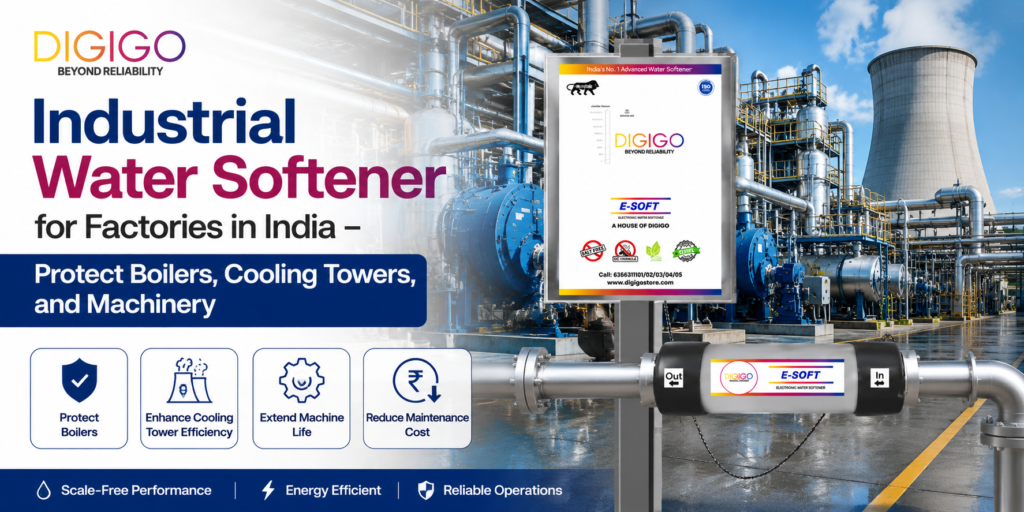
Digigo E-Soft Industrial: Chemical-free Technology for Large-scale Operations
DIGIGO’s E-Soft is built around that exact idea.
Instead of extracting calcium and magnesium, it uses controlled electronic impulses to alter how these minerals act inside water.
What happens at system level:
- larger mineral clusters break into micro-sized particles
- they remain suspended instead of sticking
- their tendency to form hard deposits reduces
The system is installed externally. No cutting pipelines. No inserting media inside flow.
In daily operation, this translates to:
- lower scale formation across boilers, pipes, and heat exchangers
- gradual loosening of older deposits
- no salt, no resin, no chemical regeneration
For large facilities, this matters because complexity drops:
- no chemical storage
- no discharge issues
- minimal ongoing intervention
DIGIGO positions itself as a water infrastructure solution provider. The focus is not on treating water as a consumable problem, but on stabilizing how it behaves across the entire system.
For factories evaluating an industrial water softener factory India, this approach fits particularly well where maintenance cycles are already stretched.
FAQ’s
1. How does E-Soft actually work inside an industrial pipeline?
E-Soft is installed externally on the pipe. It sends controlled low-frequency digital signals through the pipe wall into the flowing water.
These signals change how calcium and magnesium behave:
- large mineral clusters break into micro-sized particles
- their structure changes so they don’t stick easily
- existing deposits slowly loosen over time
So instead of removing minerals, the system prevents them from forming hard scale.
2. Does E-Soft remove hardness like a traditional water softener?
No. It does not remove calcium or magnesium.
Those minerals stay in the water, but their deposit-forming behaviour is controlled. That is why:
- pipelines stay cleaner
- heat transfer surfaces remain more efficient
- scaling reduces without chemical treatment
This is a different approach compared to salt or resin systems.
3. Will this work for boilers, cooling towers, and heat exchangers together?
Yes, and that’s where it makes the most sense.
Industrial systems are connected. The same water affects:
- boiler tubes
- cooling tower circulation
- heat exchangers
E-Soft works on the entire flow line, so it improves behaviour across all these systems instead of treating each one separately.
4. Do we still need chemicals after installing E-Soft?
In many cases, chemical dependency reduces significantly.
- Less scaling means less need for anti-scalants
- Cleaner systems reduce frequent descaling cycles
- Blowdown requirements may also reduce
However, final chemical usage depends on:
- water quality
- process requirements
- industry standards
So it’s reduction, not blind elimination.
5. Is there any salt, resin, or regeneration involved?
No.
E-Soft works without:
- salt
- resin beds
- regeneration cycles
- brine discharge
That removes:
- recurring material costs
- wastewater disposal issues
- operator dependency
It is a non-chemical, electric signal-based system.
6. Can it handle large industrial flow rates?
Yes. Industrial models are designed for high flow applications.
The system is selected based on:
- pipe size
- flow rate
- application (boiler, cooling, process)
Since it is installed externally, it does not create pressure drop or flow restriction.
7. What happens to existing scale already inside pipelines?
It does not disappear overnight.
But over time:
- old deposits start loosening
- hard layers become brittle
- flow improves gradually
This is why many plants notice improvement over weeks, not instantly.
8. Is installation complicated? Will it stop production?
Installation is straightforward.
- no pipeline cutting
- no major shutdown required
- mounted externally on the pipe
Most installations are done with minimal disruption to operations.
9. Where can this system be used in a factory?
Almost anywhere water flows:
- boilers
- cooling towers
- RO feed lines
- process pipelines
- ETP and STP systems
E-Soft is designed for multi-sector use including industrial applications.
10. What kind of maintenance does it require?
There are no consumables to replace. No chemical refilling. So this water softener requires NO MAINTENANCE.
That’s why many plants prefer it where maintenance teams are already overloaded.
Final Note
Most factories don’t ignore hard water. They just get used to dealing with it.
Cleaning becomes routine. Replacement becomes expected.
But if the same problem keeps returning, it’s worth questioning whether the solution is only managing the symptom.
Because in most plants, hard water isn’t a sudden issue. It’s a daily one.