
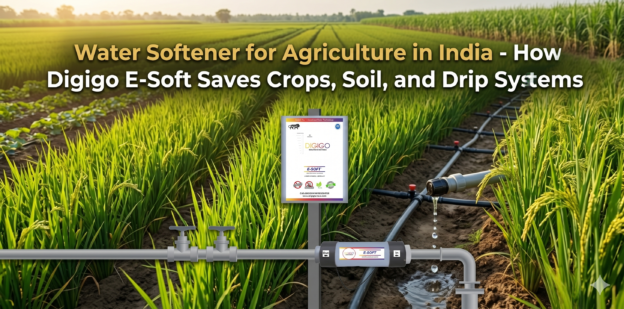
One farmer in North Gujarat once described his field like this: “Water is reaching every plant, but still something feels stuck.”
The leaves were pale. Drip lines kept choking. Fertiliser bills were rising. On paper, everything was correct. On the ground, nothing was working the way it should.
That “something stuck” is a problem most farms don’t see clearly. Hard water.
India’s Hard Water Crisis in Agriculture: What Every Farmer Must Know
Across large parts of India, especially Gujarat, Rajasthan, and parts of Maharashtra, groundwater comes with high levels of calcium and magnesium. Borewell water, which many farmers depend on, often carries these minerals in heavy concentration.
This is where hard water farming India becomes a silent challenge.
The issue is not just about water quality in drinking terms. In agriculture, hard water changes how your entire system behaves:
- Fertilisers don’t dissolve properly
- Nutrients don’t reach roots efficiently
- Soil structure slowly degrades
- Irrigation systems start clogging from inside
Many farmers assume yield problems are due to seeds, weather, or fertilizer quality. In reality, water chemistry is quietly interfering with everything.
Recent agricultural advisories and soil health reports across western India have increasingly pointed toward rising alkalinity and mineral imbalance in irrigated land. The shift is slow, but its impact compounds every season.
How Hard Water Destroys Your Drip Irrigation System
Drip irrigation is designed for precision. But hard water doesn’t respect precision.
Inside your pipes and emitters, dissolved minerals begin forming scale deposits. At first, it was invisible. Then slowly:
- Drippers lose uniform flow
- Pressure imbalance develops
- Certain crop rows get less water
- Maintenance frequency increases
Over time, farmers start noticing uneven crop growth without understanding why.
This is where agriculture water softener drip irrigation systems become critical, not optional.
From field observations and farmer experiences:
- Frequent acid flushing becomes necessary
- Filters clog faster
- Drip lines need replacement earlier than expected
The cost? Not just repairs. It is lost yield, uneven growth, and wasted fertilizer.
Many farmers end up spending lakhs over a few years just to maintain systems that were meant to save money.
Hard Water and Soil Health: Why Your Land is Becoming Alkaline
Water does not just pass through soil. It reshapes it.
When hard water is used repeatedly:
- Calcium and magnesium accumulate in the topsoil
- Soil particles bind tightly
- Porosity reduces
- Water infiltration slows down
The land becomes compact and less breathable.
From the DIGIGO field document , farmers have observed that breaking this compactness improves soil softness and moisture retention significantly.
Over time, this leads to:
- Increased alkalinity
- Reduced microbial activity
- Poor root penetration
The soil stops behaving like a living system. It becomes harder, less responsive, and less productive.
This is one of the most overlooked consequences of water softener for agriculture discussions. Most conversations stay at pipes and irrigation, but the deeper impact is happening inside the soil itself.
Crop Yield Comparison: Farms Using Soft Water vs Hard Water
Farmers who shift their water behaviour often report noticeable changes, not overnight, but across cycles.
Based on field insights and case observations:
In hard water conditions:
- Uneven crop growth
- Nutrient deficiencies despite fertiliser use
- Higher disease vulnerability
- Lower overall yield
With conditioned or softened water:
- More uniform growth
- Better nutrient absorption
- Stronger root systems
- Improved crop colour and density
Some farmers have reported yield improvements ranging from 10% to 50% depending on crop type and initial soil condition .
The difference is not magic. It is system alignment. When water behaves correctly, everything else starts working as intended.
How DIGIGO E-Soft Works With Drip, Sprinkler, and Flood Irrigation
DIGIGO positions itself as a water infrastructure solution provider. The approach is not about filtering or removing minerals. It is about changing how water behaves.
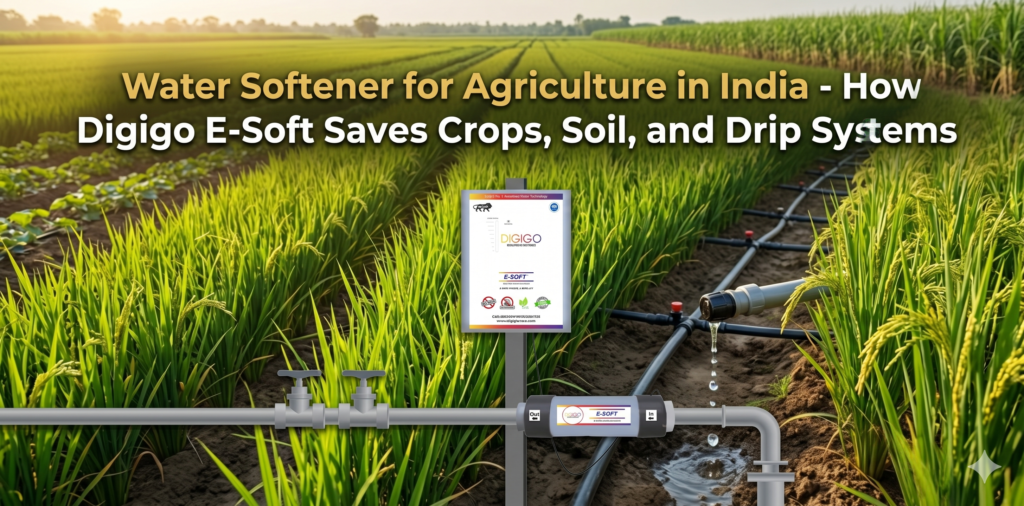
E-Soft uses electronic impulses to alter mineral structure in flowing water.
Here is what happens:
- Large mineral clusters are broken down into microscopic sizes
- Calcium and magnesium remain present but inactive
- Scale formation inside pipes reduces
- Water carries nutrients more effectively
This is why it fits seamlessly across irrigation systems:
- Drip irrigation: Prevents clogging and maintains uniform flow over time.
- Sprinkler systems: Reduces nozzle scaling and maintains spray consistency.
- Flood irrigation: Improves water penetration and reduces surface crust formation.
For farms using borewells, it acts as a borewell irrigation softener, improving how existing water interacts with soil and systems without chemical intervention.
Reducing Fertiliser Use with Soft Water – the Science Behind It
Fertilisers dissolve in water. But in hard water, mineral ions interfere with this process.
They react with fertiliser components and form compounds that plants cannot absorb easily.
This leads to:
- Nutrient lock-up
- Reduced efficiency of applied fertiliser
- Increased input costs
When water behaviour is improved:
- Fertilisers dissolve more uniformly
- Nutrients travel effectively through irrigation lines
- Root absorption improves
From field-level feedback, farmers often notice a reduction in fertiliser usage after stabilising water behaviour. Not because they use less intentionally, but because the system becomes more efficient.
This is where the idea of an agriculture water softener becomes economically relevant, not just technically interesting.
ROI for Farmers: Cost of E-Soft vs Annual Drip Repair + Fertiliser Savings
Let’s look at this practically.
Typical annual costs in hard water conditions:
- Drip maintenance and part replacement
- Acid flushing and cleaning chemicals
- Excess fertiliser usage
- Yield loss due to uneven irrigation
These are recurring costs.
On the other side, a solution like E-Soft:
- Works without salt, resin, or chemical regeneration
- Requires minimal ongoing intervention
- Protects existing infrastructure
Over a few seasons, farmers often find that:
- Maintenance costs reduce
- Fertiliser efficiency improves
- Crop output stabilises
ROI is not just about direct savings. It is about avoiding repeated losses that quietly accumulate every year.
Farmer Success Stories: Gujarat and Rajasthan case studies
If you sit with farmers long enough, you notice something. They rarely talk in technical terms. They talk in outcomes. “પાક સરખો આવ્યો”, “લાઇન ચોખી રહી”, “ખાતર બચ્યું”.
That is where the real understanding comes from.
Across Gujarat and Rajasthan, especially from field interviews and farmer videos shared through digital platforms, a consistent pattern emerges. Farmers are not chasing technology. They are trying to fix daily friction. And when water behaviour improves, multiple problems start resolving together.
1. Visnagar, North Gujarat – from “constant blockage” to stable irrigation
In one of the case discussions from North Gujarat, a farmer managing drip irrigation on vegetable crops described his earlier routine as “maintenance farming”.
Every 10 to 15 days, something would go wrong:
- Drippers clogging mid-season
- Uneven pressure across lines
- Some plants receiving less water despite full system operation
He was using borewell water, which looked clean to the eye. But internally, scale formation was building up layer by layer.
After integrating E-Soft into his irrigation line, the change was not dramatic in one day. It was gradual and noticeable over weeks:
- Drip lines started maintaining flow consistency
- Frequency of flushing reduced
- Acid cleaning cycles became less frequent
What stood out most was not just system performance, but crop uniformity. Earlier, certain rows would always lag behind. Over time, that difference reduced.
This aligns with what many farmers now learn through real field videos and shared experiences online, where practical demonstrations matter more than theory.
2. Jalore region – fertiliser behaviour started changing
Another farmer working with cumin and isabgol crops in Rajasthan noticed something unexpected.
His fertiliser usage pattern changed.
Earlier:
- He followed the same dosage every season
- Still saw inconsistent crop response
- Some patches performed better than others
After stabilising water behaviour:
- Fertiliser mixing became more uniform
- Nutrient response across the field improved
- Crop colour and density became more consistent
He did not intentionally reduce fertiliser at first. But over time, he realised he did not need to push extra input to compensate for inefficiency.
This is a subtle but powerful shift. When water carries nutrients effectively, the system stops wasting inputs.
FAQ’s
1. Does E-Soft remove minerals from water?
No. It changes mineral behaviour without removing them.
2. Is it suitable for borewell water?
Yes, it works effectively as a borewell irrigation softener.
3. Will it work with existing drip systems?
Yes. It is designed to integrate with existing irrigation setups.
4. Does it require chemicals or salt?
No. It works using electronic signals, without chemical regeneration.
5. How long before results are visible?
System improvements, like reduced clogging, may be noticed earlier. Soil and crop-level changes take a few cycles.
Closing Thought
Farming is not just about adding inputs. It is about making systems work together.
Water sits at the center of that system. When its behaviour is off, everything else struggles silently.
Understanding and correcting that behavior is where the real shift begins.
That is the role a water softener agriculture India solution is starting to play in modern farming. Not as an extra device, but as a foundational correction in how water supports crops, soil, and infrastructure.
Useful Articles:
Understanding Hard Water Challenges in Agriculture – DIGIGO Water Softeners