Tag Archives: water softener for commercial use

Water Softener for Laundry Business How Soft Water Cuts Detergent Cost and Improves Fabric Quality

Water Softener for Laundry Business: How Soft Water Cuts Detergent Cost and Improves Fabric Quality

At 6 in the morning, before the city fully wakes up, most laundry businesses in India are already running their first load. Steam rises from the machines. Workers sort hotel linen into piles. Someone tears open another detergent sack because “foam kam aa raha hai.” By afternoon, the owner notices the same problems again. Towels feel rough. White sheets look tired after just a few months. Machines need cleaning more often than expected. Electricity bills keep climbing even when business volume stays almost the same.

Most people in the laundry industry blame detergent quality, machine brand, or staff handling. Very few stop and ask a different question: what if the water itself is quietly increasing every operational cost inside the laundry?

Across India, especially in cities depending heavily on borewell supply, hard water has become a silent operational expense for commercial laundries. The problem does not arrive dramatically in one day. It builds slowly inside heaters, pipelines, fabric fibers, and washing systems until the business starts spending more to achieve the same result.

That is where water behavior starts becoming more important than most laundry owners realize.

Why Your Laundry Business is Using 30% More Detergent Than it Should

Most commercial laundries track detergent purchases carefully.

Very few track how much detergent hard water wastes before it even starts cleaning.

Hard water contains high levels of calcium and magnesium minerals. When detergent mixes with this water, part of the detergent reacts with minerals instead of dirt and oil. Foam formation drops. Cleaning efficiency reduces. Staff naturally compensate by adding more powder or liquid detergent in every cycle.

This is one of the biggest hidden reasons laundry businesses slowly increase detergent dosage over time.

In many commercial washing setups, operators notice:

  • Foam disappears quickly
  • Extra rinse cycles become common
  • Clothes feel sticky after wash
  • White linen loses brightness faster
  • Fabric smells “not fully washed”

The reaction inside the machine is simple. The detergent is fighting minerals first.

According to multiple laundry and water treatment studies, softened water can significantly reduce detergent requirement because cleaning agents perform more efficiently in low-hardness conditions.

DIGIGO’s own product material also highlights reduced soap and cleaning agent consumption after improving water behavior.

For a laundry processing hundreds of kilograms daily, even a small reduction per wash cycle creates meaningful monthly savings.

Water Softener for Laundry Business How Soft Water Cuts Detergent Cost and Improves Fabric Quality

Hard Water and Commercial Washing: The Hidden Cost Most Owners Ignore

Laundry businesses usually notice hard water only after machine problems begin.

But the real financial damage starts much earlier.

Heating Systems Slowly Lose Efficiency

Inside commercial washing machines, boilers, and heaters, mineral deposits gradually form scale layers.

Even thin scale buildup affects heat transfer efficiency.

That means:

  • Water takes longer to heat
  • Electricity consumption increases
  • Gas usage rises
  • Wash cycles become inconsistent

Many laundry owners assume their utility bills have increased because of higher production volume. Sometimes the actual reason is mineral scaling inside the heating infrastructure.

DIGIGO explains that inactive mineral behavior helps reduce scale formation inside pipelines and connected systems, helping protect infrastructure over time.

Fabric Quality Starts Degrading

Hard water affects fabric differently from regular wear and tear.

Minerals remain trapped within textile fibers after repeated washing. Over time:

  • Towels become rough
  • Bedsheets lose softness
  • Dark clothes fade unevenly
  • White linen appears dull or yellow

Hotels and hospitality businesses notice this quickly because guests immediately feel the difference in towels and bed linen.

Even when the wash cycle looks successful, the fabric no longer feels fresh.

Maintenance Becomes More Frequent

Hard water scaling affects:

  • Heating elements
  • Steam lines
  • Internal washing machine pipes
  • Spray nozzles
  • Water flow systems

Maintenance visits become “routine” when many of these repairs are actually water-related.

This is why many industrial operators now consider water management part of infrastructure planning, not only cleaning operations.

How Soft Water Reduces Detergent Use by Up to 50%

When water behaves softer, detergent can focus on cleaning instead of reacting with excess minerals.

That changes the entire wash cycle.

Better Foam Generation

Laundry workers often judge detergent performance through foam behavior.

With hard water, foam formation weakens quickly because calcium and magnesium interfere with surfactants.

Soft water improves lathering consistency, helping reduce overdosing.

DIGIGO’s E-Soft system specifically mentions increased foam performance and reduced cleaning product usage after changing hard water behavior.

Lower Rinse Requirement

Because detergent dissolves and works more effectively, fabrics rinse cleaner in fewer cycles.

This helps reduce:

  • Water usage
  • Electricity consumption
  • Cycle duration

In busy laundries processing continuous loads, saving even a few minutes per cycle improves operational efficiency across the day.

Improved Low-temperature Washing

Many laundries unknowingly increase water temperature to compensate for poor wash performance caused by hard water.

Softer water behavior allows detergents to perform better even at lower temperatures, reducing heating pressure on the system.

That directly impacts monthly utility bills.

For businesses comparing a commercial water softener system, these operational savings usually matter more than marketing claims.

Fabric Life: How Soft Water Extends Linen and Garment Lifespan

Commercial laundries rarely calculate how much money is lost through early fabric replacement.

But fabric wear is one of the largest long-term costs in hospitality and textile care businesses.

Hard water minerals remain inside fabric fibers after every wash cycle. Over time, this creates stiffness and internal friction within the textile.

The result:

  • Towel edges fray faster
  • Bedsheets thin earlier
  • Uniform colors fade quickly
  • Linen loses softness after fewer washes

Guests may never say “your water is hard.”

They simply say the towel feels old. That is the real business impact.

Soft water behavior helps fabrics rinse cleaner and maintain texture longer. For laundries handling hotel linen, salon towels, hospital fabric, or uniforms, this directly affects presentation quality and replacement frequency.

And unlike detergent costs, fabric replacement often goes unnoticed because it happens gradually throughout the year.

DIGIGO E-Soft for Laundry: Capacity Guide and Installation

DIGIGO positions itself as a water infrastructure solution provider focused on changing hard water behavior using electronic impulse technology.

Unlike salt-based systems, E-Soft does not remove minerals from water.

Instead, it uses electronic impulses and digital signals to alter mineral behavior, break larger mineral clusters into much smaller particles, and help keep calcium and magnesium inactive to reduce scaling inside systems.

This approach matters for commercial laundries because many businesses want to avoid:

  • Salt refilling
  • Chemical regeneration
  • Resin replacement
  • Water wastage
  • High-maintenance systems

For laundry operations searching for a commercial water softener system, maintenance simplicity becomes extremely important because downtime directly affects daily business.

Choosing the Right Capacity

Capacity selection usually depends on:

  • Daily washing volume
  • Number of machines
  • Boiler dependency
  • Water flow rate
  • Type of laundry operation

Small laundries may require compact commercial setups, while industrial textile units often need heavy-duty configurations.

DIGIGO offers multiple E-Soft variants for domestic and industrial applications, depending on operational load and infrastructure size.

Installation is generally done on the incoming water line so the entire washing system receives treated water behavior.

Businesses evaluating commercial soft water systems should compare long-term maintenance needs, infrastructure protection, and operating costs instead of focusing only on initial purchase price.

Monthly Savings Calculation: Detergent + Energy + Machine Maintenance

Let us take a practical example.

A medium-sized laundry processing 400 kg daily may experience monthly losses from hard water through multiple small expenses:

Expense AreaEstimated Monthly Impact
Extra detergent usage₹8,000 – ₹15,000
Higher electricity or gas usage₹5,000 – ₹12,000
Descaling chemicals and maintenance₹3,000 – ₹10,000
Early linen replacementVariable but significant

Individually, these numbers may not look alarming. Together, they create a serious operational leak.

DIGIGO’s own usage survey material also highlights significant savings across cleaning products, heating systems, plumbing infrastructure, and water-related utility expenses after improving water behavior.

That is why many businesses researching the best commercial water softener systems are now focusing on total operational efficiency instead of only detergent reduction.

And while selecting a water softener for commercial use, laundries should evaluate:

  • Infrastructure compatibility
  • Ease of maintenance
  • Operational downtime
  • Water wastage
  • Long-term scaling control

Because in commercial laundry, the real cost of hard water is rarely visible in one place. It quietly spreads across the entire business.

FAQs

1. Does DIGIGO E-Soft remove calcium and magnesium from water?

No. E-Soft does not remove minerals from water. It works by changing mineral behavior using electronic impulses and digital signals to help reduce scale formation inside systems.

2. Can soft water really reduce detergent consumption in laundry businesses?

Yes. Softer water behavior allows detergents to dissolve and clean more effectively, which can reduce overdosing and repeated rinse cycles.

3. Is E-Soft suitable for commercial laundry infrastructure?

DIGIGO offers multiple configurations suitable for domestic and industrial-scale applications, depending on water flow and operational requirements.

4. Will soft water improve fabric softness and linen life?

Hard water minerals can make fabrics rough over time. Improving water behavior helps fabrics rinse cleaner and maintain texture for longer wash cycles.

5. Why are many laundries shifting toward electronic softening systems?

Many operators prefer systems that avoid salt handling, chemical regeneration, resin maintenance, and water wastage while still helping reduce scale-related operational problems.

Useful Resources

Best Commercial Water Softener for Hotels in India – Protect Linen, Plumbing, and Guest Experience

A Comprehensive Buying Guide for Commercial Water Softener

Best Commercial Water Softener for Hotels in India

Best Commercial Water Softener for Hotels in India – Protect Linen, Plumbing, and Guest Experience

At 6:30 in the morning, before breakfast service begins, a hotel is already under pressure.

Laundry is running. Boilers are loaded. Guests are stepping into showers. Kitchen lines are active.

Everything depends on water doing its job quietly.

In many Indian hotels, it doesn’t.

Not loudly. Not dramatically. But enough to affect operations, costs, and guest experience every single day.

How Hard Water is Costing Your Hotel Lakhs of Rupees Every Year

No hotel gets a direct bill labelled “hard water damage”. Instead, it shows up in fragments.

A boiler consuming more fuel than expected.
Frequent plumbing interventions.
Higher detergent usage in laundry.
Shorter equipment life cycles.

Hard water contains calcium and magnesium. When heated or pressurised, these minerals form scale. This scale sticks to internal surfaces of pipes and equipment.

Over time:

  • Heat transfer efficiency drops
  • Water flow reduces inside pipelines
  • Systems operate under stress
  • Cleaning becomes chemical-heavy

For many mid-sized properties, these combined effects easily cross ₹2-4 lakhs annually. Not as one expense, but spread across departments where it often goes unnoticed.

Hard Water Damage in Hotels: Linen, Boilers, Kitchen Equipment, Bathrooms

The impact is not limited to one area. It spreads across the entire property.

Linen and laundry

Even with good detergents:

  • Towels lose softness
  • White linen turns dull over time
  • More chemical is required for the same output

This directly affects how guests perceive cleanliness.

Boilers and heating systems

The issue of hotel boiler scale India is a daily operational concern.

  • Scale acts as insulation
  • Heating efficiency drops
  • Fuel consumption increases
  • Risk of overheating rises

Kitchen equipment

Consistency is critical in commercial kitchens.

  • Steamers develop deposits
  • Dishwashers leave marks on glassware
  • Heating elements degrade faster

Bathrooms and fittings

This is where guests notice first.

  • Stains on taps and showerheads
  • Reduced water pressure
  • Frequent acid cleaning

Each department feels the impact differently. But the root cause is the same.

How Soft Water Improves Guest Satisfaction Scores

Guests don’t measure water hardness. They feel it.

A smoother shower.
Softer towels.
Cleaner-looking bathrooms.

These are small touchpoints, but they shape perception.

Hotels that invest in a proper water softener for hospitality setups often notice:

  • Better comfort during showers
  • Reduced complaints about dryness or roughness
  • Improved consistency across rooms

This doesn’t show up as a technical upgrade. It shows up in reviews and repeat stays.
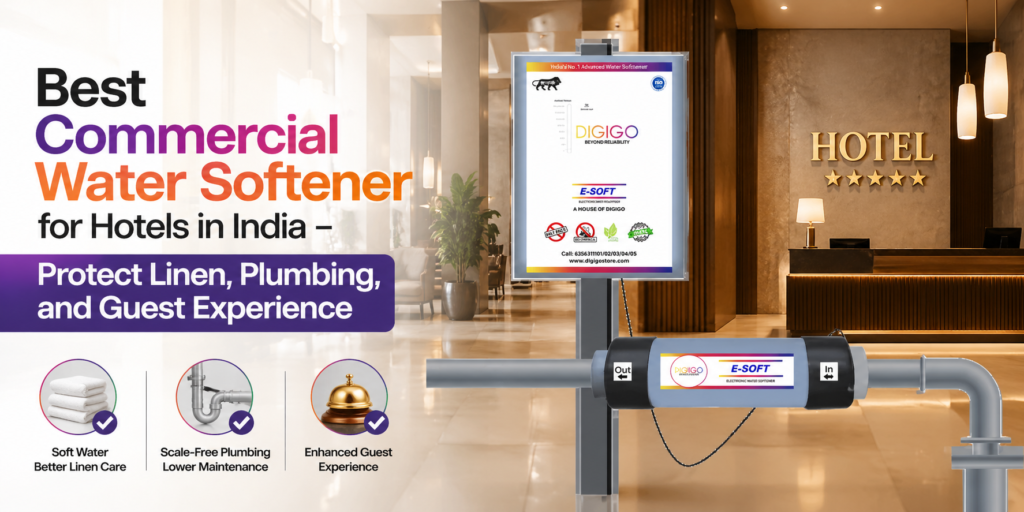
Best Commercial Water Softener for Hotels in India

Choosing the Right Capacity Water Softener for Your Hotel Size

This is where many decisions go wrong. Hotels don’t operate on average usage. They operate on peak demand.

Morning hours, laundry cycles, and kitchen operations create sudden spikes.

So while selecting a commercial water softener hotel India solution, consider:

  • Number of rooms and occupancy pattern
  • Laundry and kitchen load
  • Peak-hour demand, not daily average

A 50-room hotel, for example, does not behave like 50 households. The system must handle simultaneous usage without a performance drop.

Choosing the right capacity is less about brochure numbers and more about understanding how your property actually runs.

Digigo E-Soft Commercial Water Softener: ROI Calculation For a 50-room Hotel

Let’s look at a realistic scenario. A 50-room hotel in a hard water region:

Annual impact without treatment

  • Extra fuel due to scaling: ₹1-1.5 lakh
  • Maintenance and descaling: ₹70,000-₹1 lakh
  • Linen damage and detergent overuse: ₹50,000-₹80,000
  • Equipment wear and replacements: ₹50,000+

Total impact often crosses ₹3 lakh per year.

Now consider a system like DIGIGO E-Soft, which works differently.

It uses electronic impulses to change how minerals behave in water.

  • Breaks down larger mineral clusters into microscopic particles
  • Keeps calcium and magnesium inactive
  • Reduces their tendency to form scale

No removal of minerals. No chemical process.

If such a system reduces even 40 percent of the above losses, the savings become significant. This is why many hotels see a water softener for commercial use as a cost control decision rather than an upgrade.

Installation, Maintenance, and Ongoing Costs – Full Breakdown

This is where operational practicality matters.

Installation

  • Installed externally on pipelines
  • No major civil work required
  • No disruption to hotel operations

Maintenance

  • No salt refilling
  • No resin replacement
  • No regeneration cycles

Ongoing costs

  • Minimal electricity usage
  • No recurring consumables

Compared to traditional systems, the involvement of staff is significantly lower. For hotels managing multiple systems daily, this simplicity matters.

Why Every Business Needs a DIGIGO Water Softener in India – from Restaurants to Hotels & Hospitals

FAQ’s

  • Does this remove hardness from water?
    Yes. This hotel water softener India breaks down the larger hard minerals into micro-neutral size, so the behavior of the water changes. Eventually, the TDS of the water decreases, and the water is soft now.
  • Is it suitable for large hotels?
    Yes. Systems can be scaled based on pipeline size and demand.
  • Will it affect drinking water?
    No. It does not add or remove chemicals. In fact, soft water is safe to drink.
  • How soon are results visible?
    Reduction in scaling and cleaning effort can be noticed within weeks. Existing buildup may gradually reduce over time.
  • How is it different from traditional softeners?
    No salt, no resin, no regeneration. Lower operational involvement. This E-Soft commercial water softener requires no maintenance.

Closing Thought

Hotels often invest heavily in what guests can see. But water is something they experience repeatedly throughout their stay.

If it doesn’t behave right, it reflects everywhere. In comfort, in cleanliness, in maintenance load.

Choosing the right commercial water softener hotel India approach is not about adding another system.

It’s about fixing a foundational layer that affects everything above it.