
Contents
Introduction
Last winter, a friend called in frustration. His geyser had stopped heating properly, his bathroom tiles had turned patchy white, and his washing machine had started making a strange grinding sound. He thought all three problems were unrelated.
They were not. What he was seeing was not a product failure. It was a system reacting to something deeper. The water flowing through his home had slowly been changing the way his infrastructure behaved.
Across Indian cities, especially where borewell and mixed water sources are common, this story is becoming familiar. People notice the symptoms late, but the process starts much earlier.
Choosing a water softener is not just about buying a device. It is about understanding how water interacts with your home.
This guide is built to help you make that decision with clarity.
What is the Purpose of Using a Water Softener?
Before comparing options, it helps to step back and understand why people install a water softener for homes in the first place.
Hard water carries minerals like calcium and magnesium. These minerals are not harmful to drink, but they behave differently when exposed to heat, pressure, and surfaces.
Over time, this leads to:
- Scale formation inside pipes and appliances
- Reduced efficiency of heaters and geysers
- Increased detergent consumption
- Stains on bathroom fittings and tiles
- Roughness in laundry and bathing experience
The purpose of a system is not just to “treat water,” but to manage how these minerals behave inside your plumbing network.
This is where modern approaches are changing the conversation.
Traditional systems try to remove minerals. Newer technologies, like the DIGIGO E-Soft Water Softener for Homes, focus on altering mineral behavior so they do not form deposits in the first place.
This shift is important because it impacts maintenance, cost, and long-term performance.
What Type of Water Softener Do You Need?
When exploring the market, you will come across different types of systems. Choosing the right water softener for Homes depends on how you want to manage your water, not just the specifications on paper.
1. Salt-Based Systems (Ion Exchange)
These systems replace calcium and magnesium with sodium using resin beads.
They are widely used but come with certain operational requirements:
- Regular salt refilling
- Periodic regeneration cycles
- Water wastage during cleaning
- Dependency on plumbing modifications
They work well in certain setups but require ongoing involvement.
2. Reverse Osmosis Systems
Often misunderstood, RO systems are designed for drinking water purification. They remove dissolved solids but are not designed to act as a whole-house solution.
Using them as a substitute for a home water softener creates gaps in coverage.
3. Electronic or Signal-Based Systems
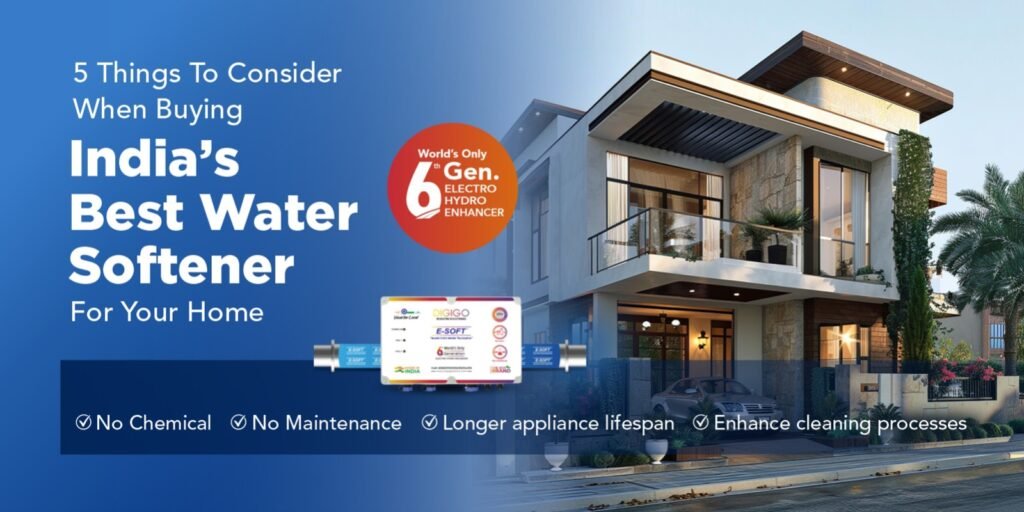
This is where innovation is happening. 6th generation systems like E-Soft work by sending electronic impulses through water lines. These signals influence how minerals behave:
- Large mineral clusters are broken down into micro-sized particles
- Calcium and magnesium remain present but inactive
- Scale formation reduces across pipes, heaters, and fixtures
There is no salt, no resin, and no chemical regeneration involved.
For many Indian households, especially those looking for low-maintenance infrastructure solutions, this approach aligns better with everyday usage.
What is the Size of the Water Softener?
Sizing is one of the most misunderstood parts of buying a system.
People often assume bigger is better. In reality, the right size depends on how water flows through your home.
When selecting a water softener for residential use, consider:
- Number of bathrooms
- Total water consumption
- Type of water source (municipal, borewell, tanker)
- Pipe diameter and entry point
Traditional systems rely heavily on capacity calculations because they store and process water in batches.
In contrast, electronic water enhancer systems like E-Soft are installed on the pipeline and work continuously as water flows. This makes sizing simpler and more adaptable.
However, placement becomes critical. The system should be installed at a point where it can influence the entire water network.
A well-sized system is not about volume alone. It is about coverage and consistency.
What Kind of Customer Support Will Be Provided?
This is often overlooked during purchase but becomes important later. Water treatment is not a one-time decision. It is an ongoing part of your home infrastructure.
When evaluating a provider, ask:
- Is installation support available?
- Will someone guide you on placement and setup?
- What happens if performance issues arise?
- Is there periodic servicing required?
Traditional systems often need regular servicing due to salt refilling and resin maintenance.
With electronic systems, maintenance is minimal, but support still matters for correct installation and performance monitoring.
DIGIGO positions itself as a water infrastructure solution provider, which means the focus extends beyond selling a unit. The idea is to ensure the system integrates smoothly with your home’s water network.
Reliable support reduces friction and builds long-term trust.
FAQ’s
1. Is a water softener necessary for every home?
Not every home needs one, but in regions with hard water, it becomes important. If you notice scaling, appliance inefficiency, or increased cleaning effort, a system can help.
2. Will a hard water softener for homes remove minerals completely?
It depends on the technology. Salt-based systems remove minerals, while electronic systems like E-Soft alter their behavior without removing them.
3. Does a home water softener affect drinking water?
Whole-house systems primarily impact water used for bathing, cleaning, and appliances. And 6th generation electro hydro enhancers like E-soft make the water safe for drinking.
4. Is maintenance expensive?
Traditional systems may involve recurring costs for salt and servicing. Electronic systems typically have no maintenance requirements.
5. How long does installation take?
Most systems can be installed within a few hours, depending on plumbing access and layout.
Final Take
Buying a water softener is not about choosing the most popular product. It is about understanding how water behaves inside your home and selecting a system that works with that reality.
A good water softener for homes should:
- Fit your water usage pattern
- Align with your maintenance preference
- Integrate easily into your plumbing
- Provide long-term stability without constant intervention
As Indian households continue to rely on mixed water sources, the focus is slowly shifting from removal to management.
That is where solutions like DIGIGO E-Soft stand out. By working on mineral behavior instead of eliminating it, they offer a practical way to reduce scale and protect infrastructure without adding operational complexity.
In the end, the right choice is the one that makes your home run smoother without demanding your constant attention.
Also read: