
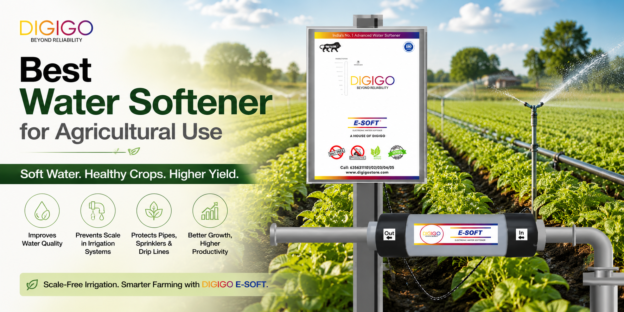
“Pichle saal tak paani theek tha… iss saal fasal kyun gir gayi?”
A farmer in Rajasthan recently raised this concern during a local agriculture discussion. What made it confusing was that the rainfall hadn’t failed. In fact, water availability looked normal, but something wasn’t working.
Recent reports have highlighted that a significant portion of groundwater across Indian states is becoming overexploited, and more importantly, its quality is deteriorating. As farmers dig deeper borewells, they are accessing water that carries higher levels of dissolved minerals.
So the real question is changing.
It’s no longer just “Do we have enough water?”
It’s becoming: “Is the water we’re using actually helping our crops grow?”
Because in many fields today, the problem is not visible like drought. It’s hidden in mineral-heavy water, tightening soil, and slowly clogging irrigation systems.
And that’s where understanding a water softener for Agriculture becomes not just useful but necessary.
What is a Water Softener?
At its simplest, a water softener is a system designed to deal with “hard water.”
Hard water contains high levels of minerals like calcium and magnesium. While these minerals are naturally present and even beneficial in small amounts, their behavior in irrigation systems can create challenges.
Traditional water softeners:
- Remove calcium and magnesium
- Replace them with sodium
- Use salt and resin
- Require periodic regeneration
But in agriculture, the goal is slightly different.
Instead of removing minerals completely, the focus is often on ensuring they don’t interfere with soil, irrigation systems, and nutrient absorption.
This is where the idea of a water softener for Agriculture becomes more nuanced than conventional household systems.
Water Quality in Crop Production
Farmers invest heavily in:
- High-quality seeds
- Fertilizers
- Modern irrigation systems
But water, the medium that carries everything to the plant is often overlooked.
When irrigation water is hard:
● Soil Structure Changes
Excess minerals can bind soil particles tightly, making the soil compact. This reduces aeration and limits root growth.
● Nutrient Locking
Fertilizers may be added in the right quantity, but minerals in water can react with them, reducing availability to plants.
● Irrigation System Damage
Scale buildup inside drip lines and pipelines leads to:
- Uneven water distribution
- Frequent clogging
- Increased maintenance costs
● Reduced Efficiency of Inputs
More fertilizer does not always mean better yield especially if water is limiting how nutrients are delivered.
This is why the application of agricultural water softener goes beyond just treating water; it affects the entire farming system.
What is the Difference Between a Water Conditioner and a Water Softener?
This is an important distinction, especially for agricultural use.
Traditional Water Softeners
- Remove hardness minerals
- Use salt-based ion exchange
- Produce wastewater
- Require ongoing maintenance
Water Conditioners
- Do not remove minerals
- Change how minerals behave in water
- Prevent scaling and deposits
- Keep systems cleaner
In farming, removing minerals completely is not always ideal because calcium and magnesium are also essential nutrients.
The real challenge is preventing these minerals from forming deposits or interfering with soil and irrigation systems.
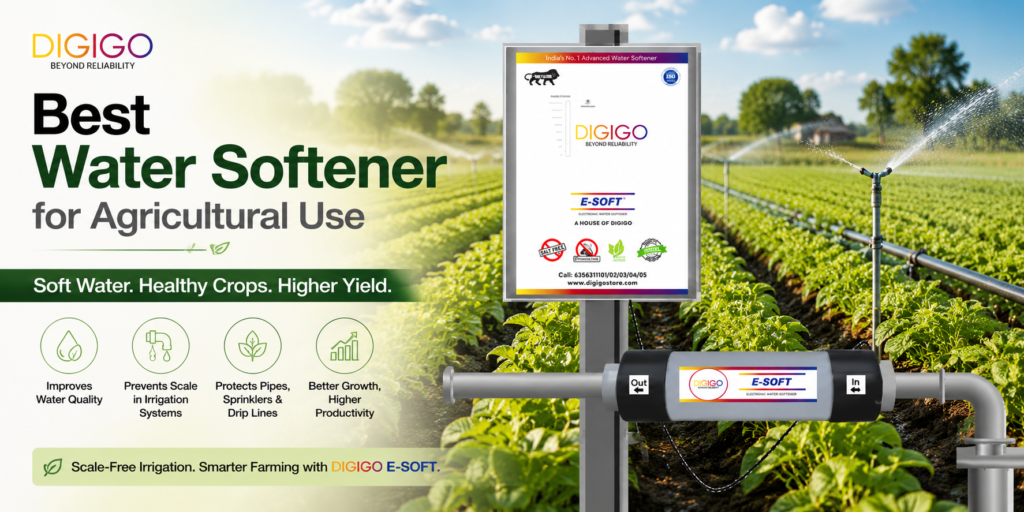
This is where modern approaches, including solutions developed by DIGIGO, come into discussion. Their E-Soft technology, for example, focuses on changing mineral behavior rather than eliminating it.
Using Water Softener for Irrigation Systems
When farmers start searching for the best Agriculture Water Softener, they are usually facing practical, on-ground issues:
- Drip irrigation clogging
- Hard soil over time
- Uneven crop growth
- Rising fertilizer usage
- Unexpected drop in yield
What Improves with the Right Approach?
1. Irrigation Flow Consistency
Reducing scale formation helps maintain uniform water distribution across fields.
2. Soil Health
When mineral buildup is controlled:
- Soil remains loose
- Water penetrates better
- Roots can expand more easily
Field observations suggest that modifying mineral structure can help improve soil texture and moisture retention .
3. Nutrient Efficiency
Water that does not interfere with fertilizers ensures better nutrient delivery to roots.
4. Crop Performance
Healthier roots and better nutrient uptake often translate into:
- Stronger plants
- Better resistance to stress
- Improved overall growth
5. Lower Maintenance
Farmers spend less on:
- Acid cleaning
- Pipe replacements
- Drip maintenance
Refer these articles
Water Softener for Agriculture in India – How Digigo E-Soft Saves Crops, Soil, and Drip Systems
Understanding Hard Water Challenges in Agriculture
A Different Approach: Electronic Water Treatment
Modern agriculture is gradually exploring non-chemical, non-salt solutions.
One such approach is the E-Soft Agricultural Water Softener, which works differently from traditional systems.
Instead of removing minerals, it:
- Uses electronic impulses
- Breaks large mineral clusters into micro-sized particles (~0.5 microns)
- Keeps calcium and magnesium inactive in terms of scaling
- Prevents deposits inside pipes and soil pathways
This allows:
- No salt usage
- No chemical regeneration
- No water wastage
How E-Soft Water Softeners Can Be Beneficial in Agriculture
Based on field-level insights:
- Soil becomes softer and easier to work with
- Roots grow stronger and deeper
- Water spreads more evenly across the field
- Drip systems remain cleaner for longer
Some observations have also reported yield improvements depending on crop type and conditions, sometimes ranging from 10% to 50% .
However, results vary based on:
- Water hardness level
- Soil composition
- Crop type
So, it should be seen as a system improvement tool, not a one-size-fits-all solution.
Choosing the Right System: What Should Farmers Consider?
Before selecting any system, it’s important to understand the root problem.
Ask:
- Is your irrigation system clogging frequently?
- Has your soil become harder over time?
- Are fertilizer costs increasing without matching yield?
- Is water coming from deep borewells with high mineral content?
The best Agriculture Water Softener is not about brand or price, it’s about fit for your specific farming conditions.
Closing Perspective
For years, farmers have been told to improve seeds, increase fertilizers, and upgrade irrigation systems.
But very rarely has anyone stood beside them and said: “Let’s fix the water you’re working with.”
Because when water improves, everything connected to it starts improving quietly.
- Soil becomes softer and holds moisture longer
- Roots grow stronger and crops become more resilient
- Fertilizer and pesticide dependency begins to reduce
- Irrigation systems stay cleaner, cutting down recurring costs
- And most importantly, farm income becomes more stable over time
This is not just about solving a technical issue. It’s about restoring balance in the way farming systems work.
Field observations have shown that when water behavior is corrected:
- Crop quality improves
- Plants develop stronger immunity
- Yields can increase significantly in the right conditions
- And farmers spend less time fixing problems and more time focusing on growth
This shift matters. Because today’s farmer is not lacking effort, they are often lacking the right support at the system level.
Solutions like the DIGIGO E-Soft water softener are not just tools. They are part of a larger movement toward making farming more efficient, less dependent, and more predictable.
And that’s where the real empowerment lies.
Because when water starts working with the farmer, farming stops feeling like a constant struggle, and starts becoming a system they can truly control and grow with.