
There’s a very specific moment most homeowners remember.
The plumber unscrews the geyser rod, taps it twice on the floor, and a chalky layer starts flaking off. Not dust. Not rust. Something harder. Almost like stone.
“Yeh paani ka kaam hai,” he says.
That sentence usually ends the conversation. But it should actually start one.
Because if your home runs on borewell supply, that “kaam” is happening everywhere. Inside pipes you can’t see. Inside appliances you’ve paid for. Slowly, consistently, without noise.
Contents
- 1 What is Borewell Water and Why is It So Hard in India?
- 2 Borewell Water TDS in India: State-wise Guide
- 3 Is Borewell Water Safe for Drinking, Cooking, and Bathing?
- 4 How to Test Borewell Water TDS at Home (Step-by-Step)
- 5 What Happens to Your Home When You use Untreated Borewell Water for Years
- 6 Borewell Water Softener vs RO – Which Do You Actually Need?
- 7 Digigo E-Soft: Purpose-built for India’s Borewell Water Problem
- 8 FAQ’s
- 9 Closing Take
What is Borewell Water and Why is It So Hard in India?
Borewell water is groundwater pulled from deep below the surface. The deeper the bore, the older the water. And older water in India usually carries more dissolved minerals.
Why?
Because of how groundwater behaves here:
- Water travels through mineral-rich rock layers for years
- Over-extraction forces deeper drilling
- Recharge is inconsistent, especially in semi-arid regions
States like Gujarat and Rajasthan sit on geology that naturally releases calcium and magnesium into water. These are not contaminants. They are part of the land itself.
But in high concentration, they change how water behaves.
That is what we call hardness. And in most Indian homes dependent on borewells, hardness is not mild. It is structural.
Borewell Water TDS in India: State-wise Guide
You don’t feel TDS by looking at water. You experience it over time.
Across India, borewell water TDS varies widely depending on location:
- Gujarat (Saurashtra, North Gujarat): 500 to 2000+ ppm
- Rajasthan: often crosses 1000 ppm easily
- Karnataka outskirts: 400 to 1500 ppm
- Tamil Nadu (peri-urban areas): 600 to 2000 ppm
- Maharashtra (non-municipal zones): 300 to 1200 ppm
To put that into perspective:
- Below 300 ppm feels light and manageable
- 300 to 600 ppm starts interacting with soap and surfaces
- Above 600 ppm begins leaving deposits inside systems
Most borewell homes are operating in the third category without realising it. Which is why the next question becomes important.
Is Borewell Water Safe for Drinking, Cooking, and Bathing?
People usually ask this when they notice a taste. But safety is not just about taste.
The question is borewell water safe India, depending on what you are using it for.
Drinking
- High TDS alone doesn’t make water unsafe
- But groundwater can carry fluoride, nitrates, or heavy metals depending on region
- Testing is non-negotiable
Cooking
- Hard water interferes with heat transfer
- Dal takes longer to soften
- Tea and coffee lose sharpness
Bathing
- Soap reacts with minerals instead of cleaning
- Skin feels stretched after drying
- Hair texture changes gradually
Nothing feels alarming on day one. That is what makes it easy to ignore. But the real story of borewell water is not about safety alone. It is about long-term interaction.
How to Test Borewell Water TDS at Home (Step-by-Step)
Before you look at any borewell water treatment home India option, get a number.
A simple TDS meter is enough.
Here’s how to use it properly:
- Fill a clean glass directly from your tap
- Switch on the meter and immerse the probe
- Wait a few seconds for the reading to stabilise
- Note the value
Now do something most people don’t:
- Test early morning and evening
- Test from storage tank and directly from inlet
You’ll often see differences. That tells you your system is already interacting with the water. This small exercise gives you clarity. Not assumptions.
What Happens to Your Home When You use Untreated Borewell Water for Years
Hard water damage doesn’t arrive as a single failure. It builds quietly across systems.
If you step back and observe a 5-year-old borewell home, patterns start showing.
● Pipes and internal lines
Mineral layers slowly narrow the passage. Pressure drops, but so gradually that it feels normal.
● Geysers and heaters
A thin layer forms on heating elements. Then it thickens. Energy consumption rises without visible reason.
● Bathroom surfaces
Tiles lose their shine. Glass gets cloudy. Cleaning shifts from wiping to scrubbing.
● Kitchen impact
Utensils lose their finish. Appliances scale internally.
● Laundry
Clothes feel harsher. Detergent usage increases.
Individually, these look like maintenance issues. Together, they point to one source.
That is why treating hardness at entry level makes more sense than reacting at every endpoint.
Borewell Water Softener vs RO – Which Do You Actually Need?
This is where most decisions go wrong.
RO and softening are not competing solutions. They address different parts of the problem.
RO systems
- Designed for drinking water
- Remove dissolved solids
- Installed at one point
- Reject water during purification
A borewell water softener
- Works on how water behaves inside your system
- Installed at inlet
- Protects plumbing, appliances, surfaces
If your concern is drinking quality, RO has its role.
If your concern is scaling, maintenance, and long-term infrastructure, a water softener for Indian homes becomes relevant.
In borewell setups, both often coexist. But how the softener works matters.
Digigo E-Soft: Purpose-built for India’s Borewell Water Problem
Most people assume softening means adding something to water. Salt, chemicals, regeneration cycles.
That is one approach.
DIGIGO has taken a different route.
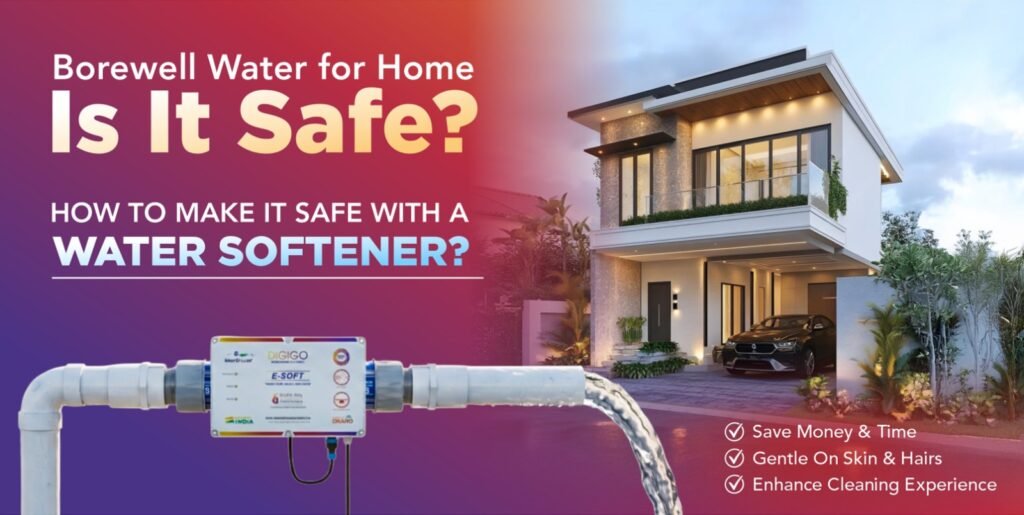
DIGIGO E-Soft is designed around a simple idea. Instead of removing minerals, change how they behave.
Here is the practical mechanism:
- A signal cable is wrapped externally around the pipeline
- The system sends programmed electronic impulses through the water flow
- These signals influence calcium and magnesium at a structural level
- Larger mineral clusters break into micro-sized particles
- The minerals remain, but their tendency to form scale reduces
What this does inside a home:
- Slows down new scale formation
- Gradually weakens existing deposits
- Improves flow consistency
- Helps systems operate closer to original efficiency
And operationally:
- No salt handling
- No chemical regeneration
- No water wastage
- Minimal intervention once installed
This makes it a practical borewell water softener approach for Indian homes where maintenance often becomes the biggest barrier.
It is important to understand the positioning clearly.
DIGIGO is not working as a purifier. It is functioning as a water infrastructure solution provider that changes hard water behaviour at the system level.
FAQ’s
1. Will this replace my drinking water system?
Yes. Soft water treated by the E-Soft water softener is safe to drink and better in taste. Drinking purification and hardness management solve different problems. E-Soft works on the latter across your home.
2. How long does it take to notice changes?
Surface-level improvements can appear early. Internal scale reduction is gradual because existing deposits need time to break down.
3. Does it work for very hard borewell water?
Yes, especially where hardness is the main issue. It is designed for conditions common in Indian groundwater.
4. Is there regular maintenance involved?
No ongoing salt or chemical cycles. Once installed, it operates with no attention.
5. Where should it be installed?
At the main inlet line, the entire house benefits, not just one outlet.
Closing Take
Borewell water is becoming the default in many Indian homes, not a backup.
The question is no longer whether you use it.
The question is whether your home is designed to handle it.
Because the real cost of hard water is rarely visible in a bill. It shows up slowly in efficiency loss, maintenance cycles, and the quiet ageing of everything water touches.
Also read about:
Best Water Softener for Home in India 2026 – Digigo E-Soft Buyer’s Guide – DIGIGO Water Softeners