The plumber didn’t knock this time. He just walked in, smiled faintly, and said, “Same issue?”
The geyser had slowed again. The taps looked older than they were. The bathroom glass refused to stay clean. Nothing had “broken,” yet everything felt off.
He opened the unit, scraped out a thick chalky layer, and left behind a sentence that didn’t sound like a repair note.
“Your water is working against your home.”
That line sits quietly in many Indian households. Because hard water doesn’t create one big problem. It creates small, repetitive problems that slowly turn into a system issue.
Contents
- 1 Why Your Home Water is Harming Your Family
- 2 What is a Water Softener and How Does it Work?
- 3 5 Things to Check Before Buying a Water Softener for Home
- 4 Why Digigo E-Soft is the Best Water Softener for Indian Homes
- 5 E-Soft vs Traditional Salt-based Softeners – Honest Comparison
- 6 How Much Does a Home Water Softener Cost in India?
- 7 FAQ’s
Why Your Home Water is Harming Your Family
In cities across India, especially in regions dependent on groundwater, hardness levels are steadily rising. You won’t see it in a glass of water. You will see it in your routine.
You wipe the same white marks from taps again and again.
Your skin feels dry even after using good products.
Your geyser takes longer to heat.
Your washing machine ages faster than expected.
These are not separate problems.
They come from the same source: minerals like calcium and magnesium that stay active in water. When heated or left to dry, they form scale. That scale sticks inside pipes, heaters, and fixtures.
Over time, this leads to:
- Reduced efficiency of appliances
- Higher electricity consumption
- Frequent maintenance and repairs
- Skin and hair discomfort
This is why people start looking for a water softener for Home India, not because of one issue, but because everything starts to feel harder to manage.
And that leads to the next question. What exactly are we trying to fix?
What is a Water Softener and How Does it Work?
A water softener is a system designed to manage hardness so that minerals do not damage your plumbing or appliances.
Traditionally, softeners follow a removal approach.
They use ion exchange. Inside the system, calcium and magnesium are replaced with sodium using resin and salt. This reduces hardness effectively, but it comes with a process. The system needs regular regeneration, uses water during cleaning cycles, and requires constant salt refilling.
There is another way to approach the same problem.
Instead of removing minerals, some modern systems focus on changing how these minerals behave in water. When minerals lose their ability to stick and form scale, the damage reduces without altering the water composition.
This distinction matters when choosing the best water softener for home India, because performance is not just about chemistry. It is about how the system fits into your daily life.
5 Things to Check Before Buying a Water Softener for Home
Many homeowners make a quick decision based on price or brand. That often leads to frustration later. A better approach is to evaluate your home first.
1. Water hardness level
Hardness varies even within the same city. A simple test gives you clarity on what level you are dealing with. Without this, you are guessing.
2. Type of system
Salt-based systems remove minerals. Electronic or salt-free systems change mineral behavior. Each has different maintenance and operational needs. Choose based on how much involvement you are comfortable with.
3. Maintenance requirement
Some systems demand regular salt refills, cleaning cycles, and servicing. Others run quietly with minimal attention. Think about your lifestyle, not just the installation.
4. Flow rate compatibility
A system should not slow down your water. If the flow rate does not match your household usage, your daily routines get affected.
5. Installation point
Whole-house systems are installed at the main inlet. Some solutions are appliance-specific. Your goal should decide the placement.
If you are planning to buy water softener 2026, these checks will save you from choosing a system that feels right initially but becomes difficult to live with.
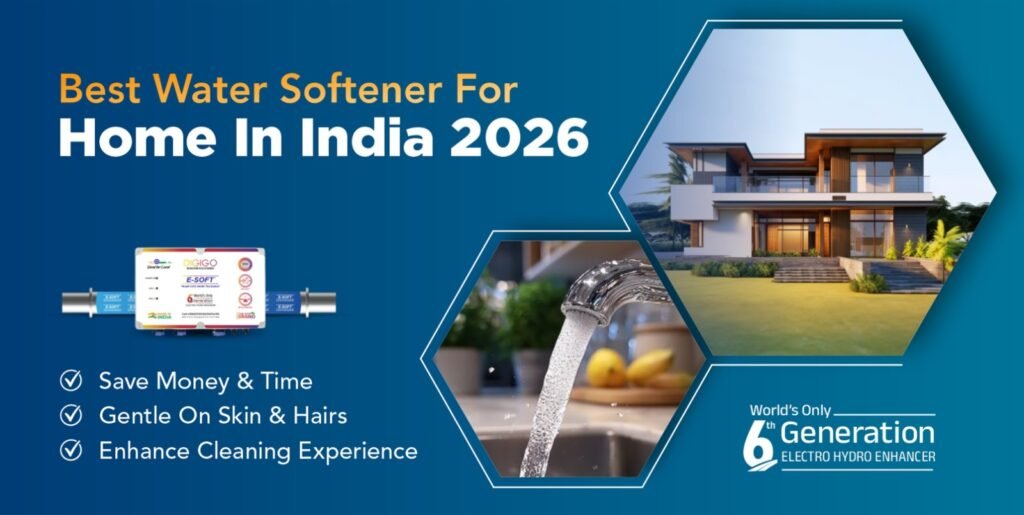
Why Digigo E-Soft is the Best Water Softener for Indian Homes
Most water solutions are designed with a treatment mindset. Indian homes need something that works with infrastructure, not against it.
DIGIGO positions itself as a water infrastructure solution provider, and E-Soft reflects that thinking.
E-Soft works on electronic impulse technology. It sends digital signals through the flowing water, interacting with dissolved minerals.
What changes is not the presence of minerals, but their behavior.
- Mineral clusters are broken down to very small sizes, around 0.5 microns
- Calcium and magnesium remain present but become inactive in terms of scaling
- Deposits reduce across pipes, heaters, and fixtures
There is no salt involved. No resin bed. No regeneration cycle running at night. No wastewater discharge.
In practical terms, this means:
- No carrying heavy salt bags
- No scheduling maintenance cycles
- No interruption in water usage
- Reduced scaling across your home
In apartments where plumbing access is limited, or in homes where maintenance becomes a burden over time, this kind of scale management system fits more naturally.
For many households searching for the best water softener for residential use India, this shift from removal to behavior management is becoming more relevant.
E-Soft vs Traditional Salt-based Softeners – Honest Comparison
Both systems address hardness, but they do it differently. The choice depends on what matters more in your home.
Traditional salt-based systems
These systems remove hardness minerals through ion exchange.
- Effective reduction of calcium and magnesium
- Requires regular salt refilling
- Needs regeneration cycles that use water
- Produces wastewater during cleaning
- Involves periodic servicing
They are widely used and can deliver strong results, but they demand attention and ongoing costs.
E-Soft electronic scale removing system
E-Soft changes how minerals behave rather than removing them.
- No removal of minerals
- Alters structure to prevent scale formation
- No salt, no chemicals
- Minimal maintenance
- Continuous operation without regeneration
The difference shows up in daily life. One system requires you to manage it. The other works quietly in the background.
This is not about declaring one universally better. It is about choosing what fits your home’s reality.
How Much Does a Home Water Softener Cost in India?
Cost becomes clearer when you look beyond the purchase price.
Initial investment
Traditional systems usually range between ₹20,000 and ₹60,000, depending on capacity and brand.
Electronic systems like E-Soft fall in a moderate to premium range.
Running cost
Salt-based systems require continuous spending on salt, water for regeneration, and occasional servicing.
E-Soft operates with minimal ongoing cost since it does not use consumables.
Long-term perspective
Many homeowners only realize the actual expense after a couple of years. What seemed affordable initially starts adding up through maintenance and effort.
When evaluated over time, the conversation shifts from price to ownership experience.
This is why people evaluating a hard water softener home India are beginning to look at systems that reduce involvement, not just hardness.
Also read about:
FAQ’s
Does a water softener make water drinkable?
Yes. A softener manages hardness. It makes water soft and makes the water TDS under safety criteria. Water softened by the E-Soft water softener is safe and healthy for drinking.
Will I notice the difference immediately?
With salt-based systems, the change is often felt in soap lather. With E-Soft, the impact becomes visible over time through reduced scaling, soap lathering, water stains, laundry, cleaning agent usage, and electricity bills.
Is E-Soft suitable for all homes?
It works well for residential setups where the goal is to protect plumbing and appliances without adding maintenance load.
Does it increase electricity consumption?
E-Soft uses electronic signals, but power usage is minimal and does not significantly affect electricity bills. In fact, when water is soft, the appliances work without extra energy consumption. Hence, it eventually decreases the electricity bill.
What if my area has very high hardness?
It is always better to assess water conditions before installation. Most residential hardness levels can be managed effectively by the E-Soft water softener.
Water problems rarely demand attention in one moment. They build quietly.
And the solution you choose should not become another system you have to manage.
The best water softener for home India in 2026 is not just about treating water. It is about making sure your home runs smoothly without constantly reminding you that something needs fixing.