Category Archives: Water Softener System

How an Industrial Water Softener Works Step-by-Step Technical Guide

How an Industrial Water Softener Works: Step-by-Step Technical Guide

On a summer afternoon, a plant head in Gujarat noticed something odd. Water consumption had gone up, even though production hadn’t.

No leaks.
No expansion in capacity.
No visible fault.

Still, the cooling tower demanded more makeup water. The boiler took longer to reach temperature. The maintenance team blamed the weather first. Then the equipment.

Weeks later, during a routine inspection, a section of pipe was opened. What they saw was not damage. It was a buildup. A thick, stubborn layer silently narrowing the system from within.

This is the part most industries don’t see. Water enters clean. Systems are designed perfectly. But over time, something changes inside. This guide is about that change. And how different water softening systems respond to it.

The Core Problem: What is Hard Water?

Hard water contains dissolved minerals, mainly calcium and magnesium. These minerals are natural, especially in groundwater sources widely used across industrial regions.

The challenge begins when water is continuously circulated through systems.

Here is how it unfolds in real operations:

●      Layer formation inside pipes

Minerals settle gradually on pipe walls. Flow paths shrink, and pressure distribution becomes uneven.

●      Reduced efficiency in heat-based systems

Boilers and chillers depend on direct heat exchange. Scale acts as a barrier, forcing systems to consume more energy.

●      Increased wear on mechanical components

Pumps and valves work harder to maintain flow. This leads to faster degradation.

●      Higher reliance on chemical correction

Many facilities introduce chemicals to manage deposits, which adds cost and operational effort.

Hard water does not interrupt production immediately. It slowly reshapes system behavior. That is why industries turn to solutions like an Industrial Water Softener to maintain consistency.
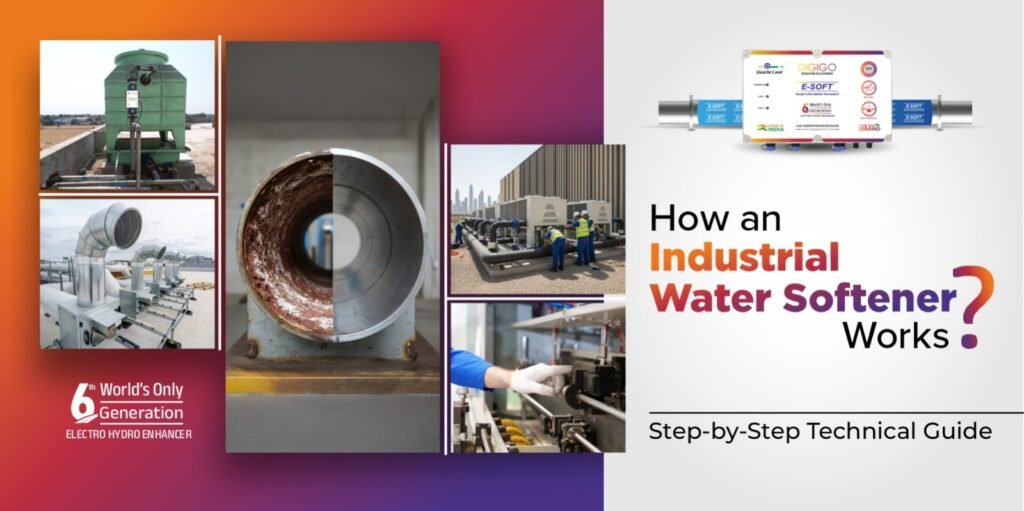
How an Industrial Water Softener Works Step-by-Step Technical Guide

A Technical Comparison between Competitor & DIGIGO E-SOFT

Understanding how a softener works requires looking at how different technologies approach the same problem.

Conventional Systems: Step-by-Step Process

Most traditional systems use ion exchange technology.

Here is the working process:

  1. Water enters a resin-filled tank: The resin is preloaded with sodium ions.
  2. Mineral exchange takes place: Calcium and magnesium attach to the resin. Sodium replaces them in the water.
  3. Softened water flows out: Hardness is reduced as minerals are removed.
  4. Regeneration cycle begins: Once the resin is saturated, a salt solution is used to recharge it.
  5. Waste discharge occurs: The process releases mineral-rich wastewater.

This method is effective in reducing hardness levels. But it introduces ongoing dependencies:

  • Regular salt consumption
  • Scheduled regeneration downtime
  • Additional water usage
  • Chemical handling

DIGIGO E-Soft: Step-by-Step Working

DIGIGO approaches water softening as an infrastructure challenge rather than a chemical one.

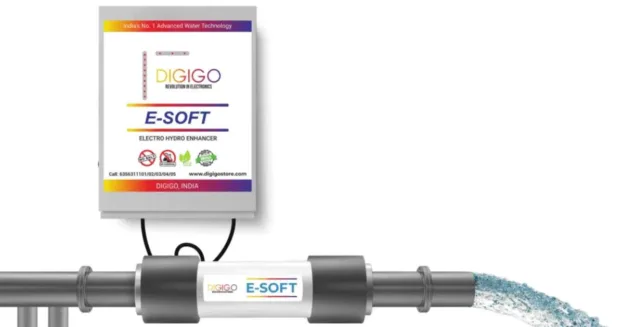
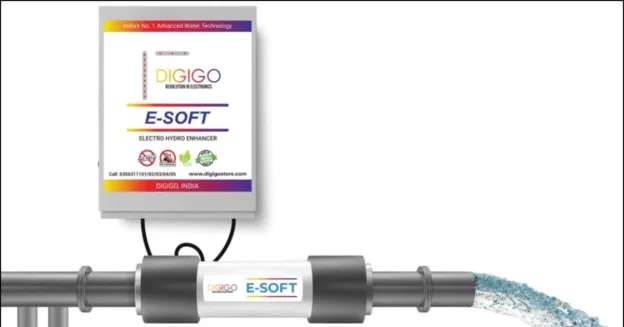
Here is How E-Soft Water Softener works in industries:

  1. Non-intrusive installation: A signal cable is wrapped externally around the pipeline. No cutting or redesign is needed.
  2. Digital signal generation: The system produces programmed low-frequency electronic impulses.
  3. Interaction with flowing water: These signals pass through the pipe and influence the water moving inside.
  4. Mineral size reduction: Larger mineral clusters are broken down into particles around 0.5 microns.
  5. Behavioral change in minerals: Calcium and magnesium remain present but become less likely to stick to surfaces.
  6. Controlled scaling inside systems: New deposits reduce significantly, and existing buildup becomes easier to manage over time.

This is the working principle of the E-Soft Industrial Water Softener.

There are no consumables involved.
There is no regeneration cycle.
There is no change in mineral content.

The system works continuously as water flows through it.

Operational Perspective

When applied in real industrial environments, the difference becomes practical:

  • Conventional systems focus on pre-treatment
  • E-Soft works within the system flow itself
  • Traditional setups need monitoring and replenishment
  • E-Soft runs with minimal operational involvement
  • Chemical-based systems create discharge
  • E-Soft keeps the process clean from additives

This shift changes how industries manage water over the long term.

What are the Considerations of Water Softeners for Industrial Use?

Choosing the right Water Softener System for Industries requires looking beyond specifications. It is about fit, function, and long-term impact.

1. Type of Application

Different industries interact with water differently.

  • Food processing focuses on consistency
  • Textile units depend on uniform reaction
  • Heavy industries rely on thermal efficiency

The solution must align with the process.

2. Ease of Integration

Industrial environments are already complex.

  • Does installation require shutdown?
  • Will it disturb existing layouts?

E-Soft integrates externally, which reduces disruption during setup.

3. Operational Stability

Continuous operations demand reliable performance.

  • Can the system handle fluctuating loads?
  • Will efficiency remain stable over time?

Consistency matters more than peak performance.

4. Maintenance Effort

Maintenance often becomes a recurring burden.

  • Salt-based systems need regular input
  • Chemical methods require supervision

One of the key Benefits of E-Soft Industrial Water Softener is the reduction in such routine tasks.

5. Cost Over Time

Initial pricing does not reflect long-term value.

Consider:

  • Energy usage due to scaling
  • Maintenance frequency
  • Equipment lifespan

A system that supports efficiency helps control indirect costs.

6. Environmental Impact

Industrial water use is closely linked to sustainability.

  • Chemical discharge affects treatment plants
  • Water wastage increases resource pressure

A system that operates without additives simplifies compliance and reduces environmental load.

Closing Take

Water does not change its nature overnight. But its effect on systems becomes visible over time.

Industrial operations depend on flow, heat transfer, and consistency. When mineral behavior interferes with these, performance begins to shift.

A traditional Industrial Water Softener focuses on removing minerals. DIGIGO focuses on managing how those minerals behave inside systems.

This difference changes how industries experience water over months and years. Instead of reacting to scale after it forms, the approach becomes about preventing resistance before it builds.

That is where infrastructure thinking starts making sense.

FAQ’s

1. What is the basic working principle of an industrial water softener?

Most systems either remove hardness minerals or control their behavior to reduce scaling inside equipment.

2. Does E-Soft remove minerals from water?

No. It changes the behavior of minerals so they do not form hard deposits.

3. Where is E-Soft typically installed?

It is installed externally on pipelines, making it suitable for boilers, cooling towers, and process lines.

4. Does it require regular maintenance?

It operates electronically and does not require salt or chemical refilling.

5. Which industries can use it?

Manufacturing, food processing, pharmaceuticals, and other water-intensive sectors can benefit from it.

If systems start asking for more without a clear reason, it is worth looking beyond machines. Sometimes, the real change is happening inside the water itself.
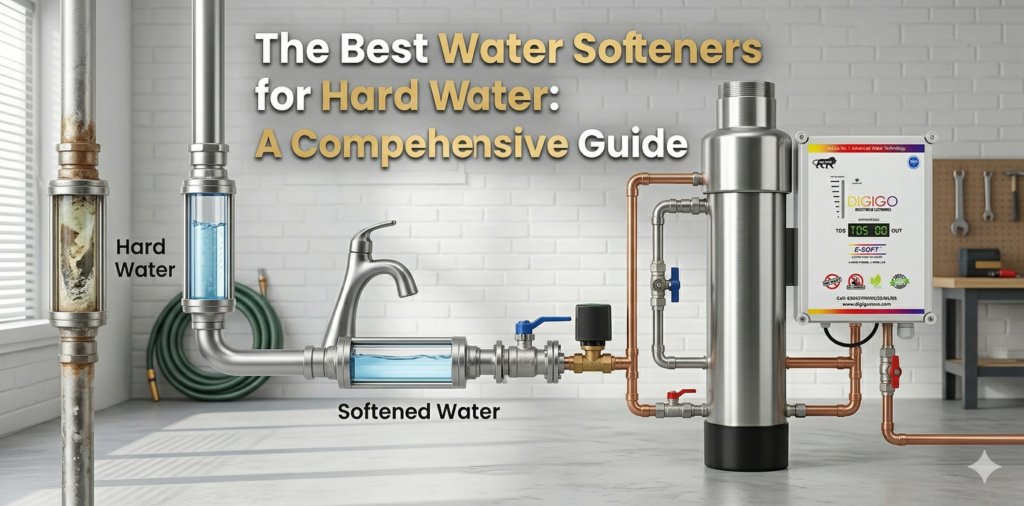
The Best Water Softeners for Hard Water A Comprehensive Guide

The Best Water Softeners for Hard Water: A Comprehensive Guide

Sunday morning in many homes follows a familiar routine.

Floors get mopped, kitchen counters are wiped, and bathroom taps are scrubbed until they shine again. But by the next week, the same white marks quietly return on the faucet, showerhead, and tiles.

Most people assume it is just normal dust or soap residue.

In reality, those faint chalky deposits are often the visible trace of hard water minerals. The same calcium and magnesium leaving marks on bathroom fixtures are also travelling through pipelines, water heaters, washing machines, and storage tanks.

Over time, those minerals settle inside infrastructure, slowly forming scale layers that affect how water systems operate.

This is why discussions around hard water softener solutions are no longer limited to large facilities. Even everyday household water systems are now being evaluated for how mineral behavior impacts long-term plumbing performance.

What is a Water Softener

A water softener is a system designed to address the operational problems caused by hard water minerals. Hardness typically comes from dissolved calcium and magnesium present in groundwater sources.

When water flows through pipelines or gets heated, these minerals tend to crystallize and stick to surfaces. The result is scale formation inside pipes, heaters, pumps, irrigation lines, and industrial equipment.

A water softener system works by reducing the impact of these minerals. Different technologies approach this challenge in different ways.

Traditional ion-exchange softeners

These systems remove calcium and magnesium ions from water and replace them with sodium ions. The process uses resin beads and requires periodic regeneration using salt.

Operationally, this approach involves:

  • Resin tanks where mineral exchange occurs
  • Salt storage for regeneration cycles
  • Wastewater discharge during cleaning cycles
  • Regular monitoring and replenishment

Ion exchange systems are widely used in environments where mineral removal is required for specific process conditions.

Electronic water softening systems

Electronic systems take a different approach. Instead of removing minerals, they influence how minerals behave in flowing water.

In general terms, these systems:

  • Use electronic impulses or digital signals around the pipeline
  • Alter mineral crystallization behaviour
  • Break larger mineral clusters into micro-scale particles
  • Keep calcium and magnesium suspended in the water flow
  • Reduce the tendency of minerals to stick to surfaces

For example, systems like the DIGIGO E-SOFT water solution operate on this principle. They work on the pipe exterior and influence water behaviour without salt, chemical regeneration, or resin tanks.

The minerals remain present in the water, but their ability to form stubborn deposits reduces.

This distinction is important because hard water management is often about controlling scale formation rather than eliminating minerals entirely.

Benefits of Water Softener

Understanding the benefits of water softener technologies requires looking beyond household comfort. Hard water affects entire water flow systems. When scale builds up, the impact spreads across plumbing, heating, irrigation, and industrial operations.

Some of the most visible system effects include the following.

1. Reduced scale formation in pipelines and equipment

Mineral deposits slowly narrow pipe diameter and create rough internal surfaces. Over time this affects water flow and pressure stability.

When mineral behaviour is managed properly, deposits form more slowly. Maintenance cycles become less frequent and plumbing infrastructure remains stable for longer periods.

2. Improved energy efficiency in heating systems

Scale is a poor conductor of heat. Even a thin mineral layer on a heating surface can significantly reduce heat transfer efficiency.

As scale thickens, heaters, boilers, and geysers require more energy to achieve the same output. In residential and industrial environments alike, energy loss is often linked to mineral buildup rather than mechanical failure.

Managing scale formation helps maintain heat transfer efficiency.

3. Lower maintenance burden

Hard water scaling is a common reason for repeated repairs. Pump seals wear faster. Valves stick. Irrigation nozzles clog. Washing equipment accumulates deposits.

Reducing mineral adherence inside flow systems decreases cleaning and repair frequency.

This is one of the practical reasons why water softener is required in many groundwater-dependent environments.

4. Stable water flow in irrigation systems

Agricultural infrastructure is especially sensitive to mineral deposits. Drip irrigation systems rely on small emitters that can easily clog.

When minerals remain suspended rather than forming deposits, irrigation lines operate more consistently and require fewer flush cycles.

5. More efficient detergent performance

Hard water minerals interact with soap and detergents, reducing their cleaning efficiency. This is why households and commercial laundries often use higher detergent quantities in hard water areas.

Water behaviour control can reduce this interaction, allowing detergents to function more effectively.

Taken together, these operational improvements explain why many sectors look for a hard water softener solution rather than treating scale as an unavoidable maintenance cost.

The Best Water Softeners for Hard Water A Comprehensive Guide

How to Choose the Best Water Softener Solution in India

Selecting the best water softener solution in India requires understanding the environment where the system will operate. Water characteristics, infrastructure design, and operational priorities vary significantly across locations.

Instead of focusing only on product features, decision-makers often evaluate several system-level considerations.

1. Water source and hardness profile

The first step is identifying where the water comes from.

Groundwater drawn from borewells often carries higher mineral loads compared to surface water sources. Hardness levels can vary depending on the aquifer structure in a region.

A water test helps determine whether hardness management is necessary and which type of approach might be suitable.

2. Infrastructure scale

Different environments require different system capacities.

For example:

  • Homes may need protection for plumbing lines and heaters
  • Residential societies may need centralized pipeline treatment
  • Farms may need irrigation flow protection
  • Industrial plants may require process-specific treatment systems

A solution should integrate smoothly with existing plumbing or pipeline layouts.

3. Maintenance expectations

Some water treatment technologies require regular manual intervention.

Traditional ion-exchange systems typically involve:

  • Salt refilling
  • Resin regeneration cycles
  • Wastewater discharge handling

Electronic systems generally operate without salt or chemical regeneration. For locations where maintenance resources are limited, this operational simplicity can influence system choice.

4. Installation practicality

In many buildings, water treatment systems must be installed within tight utility areas.

Pipeline-mounted technologies often simplify installation because they work externally without altering water flow lines.

Installation feasibility should always be evaluated before selecting a system.

5. Long-term operational cost

Upfront equipment cost is only part of the picture.

Operational considerations such as salt consumption, water wastage, electricity usage, and maintenance labor all influence the long-term cost structure.

This is why facility managers often compare lifecycle impact rather than focusing solely on initial purchase price.

When these factors are examined together, decision-makers can identify the best hard water softener solution suited to their infrastructure environment.

Also read:
Comparison: DIGIGO Hard Water Softeners vs Other Hard Water Softeners

Frequently Asked Questions (FAQs)

1. Why is hard water common in many parts of India?

Many regions rely heavily on groundwater from borewells. As water travels through mineral-rich rock layers underground, it dissolves calcium and magnesium. These minerals contribute to hardness.

2. Do water softeners remove hardness completely?

It depends on the technology used. Ion exchange systems remove calcium and magnesium ions from water. Electronic systems usually modify mineral behavior to reduce scale formation rather than removing the minerals.

3. Where are water softeners typically installed?

They are commonly installed in residential plumbing systems, agricultural irrigation pipelines, commercial buildings, and industrial water flow systems where scale formation affects operations.

4. Does a water softener change drinking water quality?

Most scale-management technologies focus on infrastructure protection rather than drinking water purification. Drinking water treatment often requires separate filtration systems depending on water quality.

5. How quickly can scale reduction be noticed?

Existing scale deposits may take time to loosen or dissolve depending on system conditions. Behavioral changes in mineral deposition patterns typically become visible gradually during regular water usage.

Closing Take

Hard water is often treated as a household inconvenience. In reality, it is a system-level challenge connected to groundwater dependence and mineral-rich aquifers.

Scale formation affects pipelines, heaters, irrigation systems, and industrial equipment. The result is reduced efficiency, higher maintenance, and increased operational cost.

A well-chosen water softener system helps address this challenge by managing mineral behavior in flowing water. Whether through mineral removal or behavior modification, the objective remains the same: protect infrastructure from long-term scale damage.

As borewell dependence continues to grow across residential, agricultural, and industrial sectors, practical scale-management solutions are becoming part of everyday water infrastructure planning.

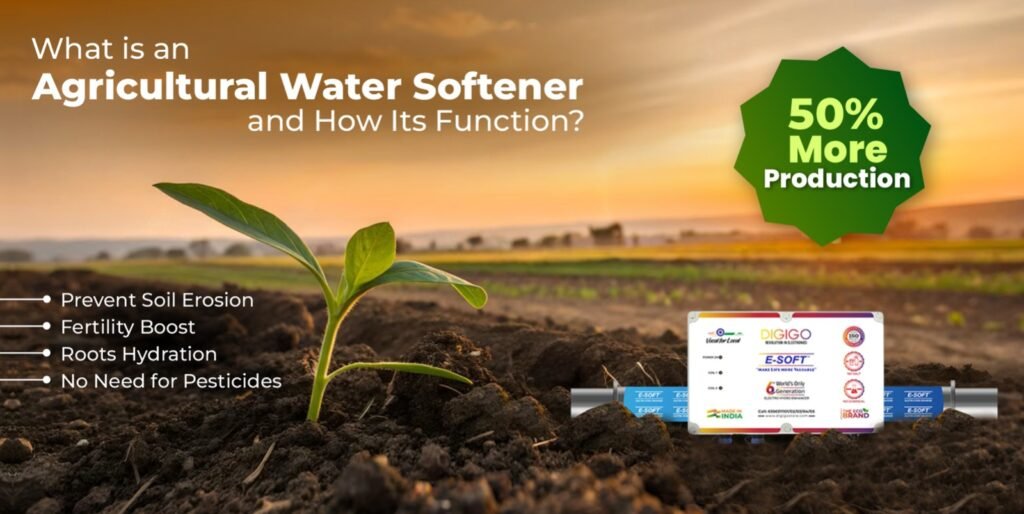
What is an Agricultural Water Softener and How Its Function

Maximize Irrigation Efficiency with Water Softeners

Around 6 AM, a farmer starts the borewell pump before the sun gets too strong. Water begins flowing through the irrigation lines across the field. At first, everything works as expected. Sprinklers rotate, drip lines release water slowly, and crops receive their share.

A few months later, something feels different.

One corner of the field looks drier than the rest. Some drip emitters release very little water. A few sprinkler heads spray unevenly. The farmer checks the pump pressure, cleans the filter, and flushes the lines. Things improve temporarily, but the issue returns after some weeks.

Many farmers face this cycle every season. The assumption is usually that the irrigation system is getting old or that soil particles are blocking the lines. But in many borewell-dependent farming areas, the real cause sits quietly inside the water itself.

Groundwater travels through layers of limestone and mineral-rich rocks before reaching borewells. By the time it reaches irrigation systems, it often carries dissolved minerals like calcium and magnesium. These minerals gradually attach to pipe walls, valves, and drip emitters, creating scale deposits.

In agriculture, this does not look like a dramatic failure. It appears slowly as uneven irrigation, frequent cleaning of drip lines, or pumps working harder than before.

Understanding this behaviour of water is important for modern farming systems. This is where a water softener for agriculture becomes part of the discussion.

What is an Agricultural Water Softener?

An agricultural water softener is a system designed to manage mineral-rich irrigation water so that it behaves more efficiently within farm infrastructure.

Hard water commonly contains high concentrations of minerals such as:

  • Calcium
  • Magnesium
  • Other dissolved mineral salts

When this water flows through irrigation pipelines and equipment, these minerals can gradually attach to internal surfaces. Over time, this leads to scaling in pipes, pumps, drip emitters, and sprinkler nozzles.

An agricultural softening system works to reduce this mineral deposition.

Traditional softeners operate using ion exchange technology. These systems remove calcium and magnesium from water and replace them with sodium. They require salt-based regeneration cycles and regular operational maintenance.

Electronic softening systems follow a different approach. Instead of removing minerals, they influence mineral behaviour.

For example, the E-Soft Agricultural Water Softener works by applying electronic impulses to the external surface of irrigation pipelines. These impulses affect the crystallization pattern of minerals in flowing water.

Rather than forming large-scale deposits that attach to surfaces, minerals tend to remain suspended in the water in smaller structures. This reduces their tendency to stick inside pipes and irrigation components.

What is an Agricultural Water Softener and How Its Function

What is the Impact of Hard Water on Agriculture?

Hard water rarely creates sudden problems on farms. The impact is usually gradual and visible through everyday irrigation challenges.

Uneven Irrigation from Drip Systems

Many farmers rely on drip irrigation to deliver water precisely to plant roots. However, the emitters in drip systems have very small openings.

Over time, minerals in hard water can accumulate inside these openings.

Farmers often observe:

  • Some plants receiving less water
  • Sections of drip lines slowing down
  • Emitters clogging repeatedly

These problems usually appear slowly across multiple irrigation cycles.

Faster Surface Drying of Soil

Another common observation in fields irrigated with mineral-heavy water is that the soil surface dries quickly.

Hard water often contains larger mineral clusters that may remain closer to the soil surface after irrigation. This can lead to faster surface evaporation compared to water that penetrates deeper into the soil.

When water remains closer to the top layer, evaporation increases, which means moisture disappears more quickly from the root zone.

In contrast, water that infiltrates deeper into the soil profile helps maintain moisture for a longer period. When water absorbs more easily into soil pores, the soil tends to stay moist for longer durations.

Because of this difference, irrigation intervals may change. In some farming situations, better soil absorption can increase the time gap between two irrigation cycles.

Increasing Chemical Dependency

Farmers sometimes respond to crop stress or lower productivity by increasing fertilizer or chemical usage.

This does not always happen directly because of hard water, but irrigation water quality can influence soil conditions and nutrient behaviour over time.

When mineral-heavy water repeatedly interacts with soil, farmers may adjust nutrient inputs to maintain crop growth.

Soil Behaviour Changes

Long-term irrigation with mineral-rich groundwater can influence soil characteristics depending on soil type and drainage conditions.

Some fields may gradually experience:

  • Reduced permeability
  • Mineral accumulation near the surface
  • Increased salinity risk in certain regions

These changes depend on multiple environmental factors, but irrigation water composition remains one of the contributing elements.

Main Role of a Water Softener for Agriculture

The role of a water softener for agriculture is not limited to treating water. Its purpose is to influence how water behaves within the irrigation system and soil environment.

Some important application of agricultural water softener systems include the following.

Managing Mineral Scaling in Irrigation Systems

Mineral scale inside the irrigation infrastructure can reduce water flow efficiency.

When mineral adhesion decreases:

  • Pipelines remain clearer
  • Sprinkler nozzles maintain their spray pattern
  • Drip emitters stay functional for longer periods

This helps irrigation systems perform closer to their intended design.

Supporting Better Soil Water Absorption

Water behaviour affects how it moves through soil layers.

When mineral particles remain smaller and suspended, water can pass more easily through soil pores. This improves soil moisture distribution around plant roots.

Better infiltration can also help reduce rapid surface evaporation in some irrigation situations.

Protecting Pumps and Equipment

Farm pumps operate under continuous load during irrigation seasons. Mineral scale can accumulate inside pump components over time.

Reducing mineral deposition helps maintain smoother internal surfaces in pipelines and pump components.

This supports more stable mechanical performance.

Reducing Irrigation Maintenance

Irrigation systems require regular monitoring and cleaning. However, mineral scaling increases maintenance frequency.

When mineral buildup is reduced, farmers may spend less time:

  • Flushing pipelines
  • Replacing drip emitters
  • Cleaning sprinkler heads
  • Servicing pumps

These practical benefits help explain how E-Soft water softeners can be beneficial in agriculture, where groundwater is the primary irrigation source.

How to Choose the Right Agricultural Water Softener?

Selecting the best agriculture water softener requires understanding both the water source and the irrigation infrastructure.

Farm decision-makers typically evaluate several operational factors.

Water Source Characteristics

Groundwater drawn from borewells often carries higher mineral loads compared to surface water sources.

Understanding water hardness levels helps determine whether mineral behaviour management is necessary.

Irrigation System Sensitivity

Different irrigation systems react differently to mineral-rich water.

For example:

  • Drip irrigation systems are highly sensitive to mineral deposits
  • Sprinkler systems can tolerate moderate scaling
  • Flood irrigation relies less on pipeline precision

Farms using drip or micro-irrigation usually prioritize scale management.

Maintenance Capacity

Some softening systems require ongoing inputs such as salt or chemical regeneration. Others operate externally on pipelines without requiring consumable materials.

Farmers often select systems that match their operational capacity and maintenance availability.

Installation Practicality

Agricultural irrigation networks cover large areas and complex pipeline layouts.

Solutions that integrate easily with existing pipelines without major structural changes are generally easier to implement.

Electronic systems are typically installed around the pipeline without cutting or modifying plumbing.

How to Use and Maintain an Agricultural Water Softener?

Agricultural softening systems are typically installed on the main irrigation pipeline, close to the pump or borewell outlet.

Once installed:

  • Irrigation water continues flowing normally
  • The system operates continuously during irrigation cycles
  • Mineral behaviour begins adjusting gradually during water flow

Maintenance requirements depend on the type of technology used.

Traditional softeners require:

  • Periodic salt refilling
  • Regeneration cycles
  • Resin maintenance

Electronic softening systems like E-Soft water softener for agriculture require no operational attention once installed.

Frequently Asked Questions (FAQs)

1. Does an agricultural water softener remove hardness completely?

Not necessarily. Some systems remove hardness minerals, while electronic systems primarily modify mineral behaviour to reduce scale formation.

2. Can these systems improve drip irrigation performance?

Managing mineral deposits can help reduce clogging risks in drip emitters and maintain more stable water flow.

3. Where are agricultural softeners usually installed?

They are typically installed on the main irrigation pipeline near the pump or borewell outlet.

4. Are these systems suitable only for large farms?

No. They are also used in smaller farms, nurseries, horticulture fields, and dairy farming operations where borewell water is used for irrigation.

A Step Towards Green Agriculture

Sustainable farming is not only about reducing chemicals or adopting modern irrigation methods. It also involves understanding how water behaves inside the farm ecosystem. In many groundwater-dependent regions, irrigation water carries minerals that slowly influence pipelines, soil moisture patterns, and irrigation efficiency.

When farmers begin managing the behaviour of these minerals, several small improvements start appearing across the system. Irrigation lines tend to remain cleaner, drip emitters maintain more consistent flow, and water can penetrate soil more effectively instead of remaining only on the surface.

Over time, these changes can support better moisture retention in the root zone. When soil stays moist for longer periods, the gap between irrigation cycles may naturally increase. This helps farms use water more thoughtfully while reducing stress on irrigation infrastructure.

Approaches that manage mineral behaviour in flowing water are gradually becoming part of modern farm water management practices. By reducing scale formation and supporting more stable water movement through irrigation systems, such technologies contribute quietly to a more efficient and resource-conscious agricultural setup.

For farms that rely heavily on borewell irrigation, improving how water interacts with both infrastructure and soil is an important step toward building a more sustainable and resilient farming environment.

Visit https://digigostore.com/ if you are looking for Hard Water Softener solution for Agriculture, Residential, Commercial or Residential. We are one of the best E-SOFT Water Softener Solution provider in India.

Why Every Business Needs a DIGIGO Water Softener in India

Why Every Business Needs a DIGIGO Water Softener in India – from Restaurants to Hotels & Hospitals

A restaurant in Ahmedabad replaces its water heater twice in three years.

A hotel in Jaipur keeps increasing detergent dosage because linens look dull.

A hospital in Indore notices scale flakes clogging lines.

Different industries. Same silent cause. Hard water!

Groundwater is the main water supply for businesses throughout the nation of India’s business sector. Bore wells tap into the minerals that are found within the aquifer beneath them. The water found there contains a high concentration of calcium and magnesium. Every day, this mineral water will flow through pipes, heaters, cooling systems, irrigation pipes and various processing equipment. And every day this mineral-rich water will continue to do exactly what good minerals do.

It deposits. And in commercial infrastructure, deposits are not cosmetic. They are operational.

This is why conversations around hard water are shifting from “water quality issue” to “system efficiency issue.”

Why Water Softener Required for Commercials

Hard water in a household creates inconvenience. In a commercial setup, it creates compounding cost layers.

In India’s borewell-dependent environments, minerals enter systems continuously. Over time, they crystallize and adhere to surfaces exposed to heat and pressure.

In commercial spaces, that means:

  • Heat exchangers lose transfer efficiency
  • Boilers consume more energy
  • Pipes narrow internally
  • Valves stick
  • Spray nozzles clog
  • Irrigation lines harden
  • Equipment life shortens

These are not sudden breakdowns. They are gradual performance losses.

Restaurants and hotels face a visible scale in kitchen equipment and dishwashers. Hospitals see mineral deposits affecting sterilization efficiency. IT parks and malls experience cooling system inefficiencies. Textile and food processing industries deal with inconsistent process temperatures due to scaling.

Hard Water is a Contributor to Structural Maintenance

Common softeners eliminate hardness via an ion exchange, using salt regeneration cycles to produce and discharge brine.

Electronic scale-control systems have a different method for controlling minerals. Rather than eliminating minerals, they alter the way that minerals function in the flow. They change the minerals down to the micron level. Thus, the minerals will maintain their suspended state and have less of a tendency to adhere to surfaces.

Both approaches exist. The choice depends on system design, discharge feasibility, and maintenance expectations.

For commercial environments where discharge management and regeneration logistics can be complex, non-salt intervention models are increasingly evaluated as part of broader hard water solutions.

Hard water is not rare in India. It is common. Especially where groundwater is the primary source.

Why Every Business Needs a DIGIGO Water Softener in India

Advantages of Water Softener System

When decision-makers assess water treatment, they are not looking for luxury. They are evaluating operational stability.

A water softener system, whether ion-exchange based or electronic anti-scale, influences infrastructure in measurable ways.

1. Energy Efficiency Stability

Scale acts as insulation inside heaters and boilers. Even a thin mineral layer reduces heat transfer efficiency. Systems then consume more energy to achieve the same output.

Reducing scale formation helps:

  • Maintain consistent heating performance
  • Lower avoidable energy load
  • Reduce overheating stress

In industries where thermal processes are core operations, this impact compounds over time.

2. Maintenance Cycle Reduction

Many maintenance calls are not due to component failure but mineral buildup.

Scale contributes to:

  • Blocked pipelines
  • Reduced water pressure
  • Stuck valves
  • Pump inefficiency

Managing mineral behaviour extends cleaning intervals and reduces unplanned downtime.

3. Equipment Longevity

In commercial kitchens, laundries, cooling towers, and irrigation systems, mineral buildup accelerates wear.

By limiting deposition:

  • Surface corrosion reduces
  • Gaskets and seals last longer
  • Flow uniformity improves

This becomes especially relevant for facility managers comparing the best water softeners for hard water in operational environments.

4. Water Behaviour in Agriculture

In farms and dairy operations, mineral-heavy water affects more than pipes.

Over time, irrigation with hard water influences:

  • Soil structure
  • Drip-line clogging
  • Nutrient distribution

While hardness is not the only agricultural variable, scale inside irrigation lines increases cleaning cycles and disrupts uniform flow.

Commercial agriculture increasingly views water treatment as a system-efficiency decision, not just a domestic concern.

Best Water Softener for Commercial: What Businesses Actually Need to Evaluate

The phrase best water softener for commercial use is often searched. But suitability depends on the infrastructure context.

Decision-makers typically evaluate based on:

  • Source water profile (borewell, municipal blend)
  • Flow rate requirements
  • Discharge feasibility
  • Installation constraints
  • Maintenance capacity
  • Long-term operating cost

In India, where discharge management can be restrictive and salt handling may not be feasible for large facilities, alternative scale-management systems are often reviewed alongside traditional softeners.

Electronic descaling systems, such as DIGIGO’s E-Soft, operate without salt or chemical regeneration. They use electronic impulses to influence mineral solidification behaviour.

They do not remove hardness. They aim to reduce scale adhesion. This distinction matters.

For commercial setups where:

  • Continuous flow is critical
  • Shutdowns are expensive
  • Maintenance teams are limited
  • Water discharge regulations apply

A non-regenerative system may align better with operational realities.

That is why conversations around the best hard water softener in India increasingly include system-fit discussions rather than single-technology comparisons.

How DIGIGO E-Soft Supports Commercial Water Systems

DIGIGO functions within real water-use environments: homes, farms, industries, and commercial infrastructure.

E-Soft integrates into existing plumbing lines. It is installed externally without cutting major infrastructure or introducing chemical tanks.

Its operating principle is straightforward:

  • Electronic signals pass through the pipeline
  • Mineral deposition behaviour alters
  • Calcium and magnesium remain present
  • Adhesion to surfaces reduces

In practice, this means scale formation risk lowers over time within flowing systems. For commercial users, the relevance lies in:

1. Infrastructure Compatibility

No salt storage.
No regeneration cycles.
No brine discharge management.

This reduces dependency on consumables and simplifies installation in high-occupancy facilities like hotels, hospitals, malls, and IT parks.

2. Continuous Operation

Electronic systems operate as long as the power supply is stable. There are no regeneration downtime cycles. For restaurants and processing units running daily operations, this continuity supports workflow stability.

3. Energy and Efficiency Context

Since scale contributes to energy inefficiency, reducing deposition risk indirectly supports consistent thermal performance. It does not eliminate maintenance, but it addresses one of the root causes of energy loss in mineral-heavy water environments.

4. Multi-Sector Relevance

DIGIGO systems operate across:

  • Residential plumbing systems
  • Agriculture irrigation ecosystems
  • Industrial water flow systems
  • Commercial infrastructure

This cross-sector exposure reflects an understanding of how mineral behaviour interacts differently across heaters, drip lines, cooling towers, and processing units.

It is not positioned as a purifier. It does not claim to be drinking-grade water. It addresses scale behaviour within infrastructure.

For facility managers comparing a water softener for home in India versus commercial installations, scale dynamics differ significantly due to flow rates and system complexity. Commercial systems require integration thinking, not appliance thinking.

Concluding Words

In India’s groundwater-dependent reality, hard water is not a temporary inconvenience. It is an ongoing infrastructure variable.

Restaurants see it in dishwashers.
Hotels see it in boilers.
Hospitals see it in sterilization lines.
Farms see it in drip irrigation.
Industries see it in heat transfer systems.

Hard water affects energy, maintenance, and system lifespan. Water treatment decisions, therefore, influence cost structures beyond plumbing.

The best hard water softener in India is not defined by advertising language. It is defined by infrastructure fit, maintenance practicality, and long-term usability.

Commercial water systems require clarity, not exaggeration. The scale is predictable. But the behaviour of the water can be managed.  Infrastructure decisions should reflect operational reality.

FAQs

1. Does a commercial water softener remove hardness completely?

Traditional ion-exchange softeners remove calcium and magnesium. Electronic scale-management systems modify mineral behaviour but do not remove hardness. Selection depends on system goals and operational constraints.

2. Is hard water common across India?

Yes. Many regions rely on groundwater drawn from mineral-rich aquifers. Borewell dependence has increased in urban and semi-urban areas, making hardness a frequent infrastructure concern.

3. Is an electronic system suitable for industrial use?

Electronic descaling systems are used in industrial flow-line environments where scale management is required without salt regeneration. Suitability depends on flow rate, pipe material, and system design.

4. Does scale really affect energy consumption?

Yes. Mineral buildup reduces heat transfer efficiency in boilers and heaters. Even thin layers can increase energy demand over time.

5. How is this different from a purifier?

A purifier targets drinking water quality. A scale-management system addresses mineral deposition within plumbing and equipment infrastructure.

Water is not just about quality at the tap. In commercial environments, it is about how it behaves inside the system.

Digigo Esoft Water Softener

Comparison: DIGIGO Hard Water Softeners vs Other Hard Water Softeners

Blog Overview:

  • Understand what makes Digigo hard water softener stand out.
  • Know the real difference between TDS and hardness.
  • Read real-life stories of Indian families solving hard water problems.
  • Discover expert insights and online reviews.
  • Learn what to look for in a softener for your home.

Introduction: Why My Geyser Gave Up Early?

“Why does my new geyser need servicing again?”

That’s exactly what my aunt said last summer. She’d just installed a fancy new geyser, and within months, white stains and low water pressure became a regular issue. The culprit? Borewell water. And like many Indian homes, her house depend completely on it.

Hard water isn’t just a pipe or appliance issue; it slowly affects skin, hair, clothes, and even daily peace of mind. That’s when someone in our family WhatsApp group said, “Try a Digigo hard water softener. We used it, and our bathroom tap stains just vanished!”

That got me curious. What’s so special about Digigo? How is it different from other softeners? And how do we know if it’s the right one for our home?

Let’s break it down simply.

TDS vs Hardness: Don’t Mix the Two

Most people think a high TDS level in water means it’s hard water. But that’s not always true.

Let’s understand the difference:

  • TDS (Total Dissolved Solids) includes all salts and minerals in water, not all of which are bad.
  • Hardness comes from calcium and magnesium ions, specifically, these are what leave white scale and make water “hard.”

For example, a glass of mineral water may have high TDS but is soft to the touch. Meanwhile, borewell water with high calcium can ruin your taps, even with lower TDS.

So, the next time someone says “check your TDS”, also ask: What’s the calcium and magnesium content?

Do Softeners Reduce TDS? The Truth

This is a common myth.

No, most water softeners, including the Digigo hard water softener, do not reduce TDS. They replace calcium and magnesium with sodium or potassium, making the water soft.

Why is this important?

Because even with the same TDS, softened water:

  • Doesn’t form white scales.
  • Feels gentler on skin.
  • Don’t choke your geysers or washing machines.
  • Stats say: 70% of Indian households that use borewell water have hardness levels above the recommended 200 ppm.

Authentic Narrative: Transitioning from Uncomfortable, Itchy Skin to Delightfully Smooth Mornings

Hi Ramesh from Nagpur. He got a water softener installed for domestic use after his children began developing dry, scratchy skin.

“Since making the change to a Digigo softener, we’ve noticed that even our clothes are noticeably softer to the touch and more pleasant to wear. We no longer have any problem with shampoo foam, either,” he reports.

This is quite a common occurrence. Hard water has a tendency to react with soap, and this causes it to not lather as it should or as effectively, and it also leaves a nasty residue on the hair and skin.

Why Digigo Hard Water Softener?

There are many brands. So why are people choosing Digigo?

Here’s a side-by-side look (simplified):

FeatureDigigo Hard Water SoftenerOther Brands
Price RangeMid-affordable for homesVaries
InstallationEasy, home-readySometimes complex
MaintenanceLow, filter-basedResin cleaning needed
AvailabilityOnline & OfflineLimited access
SuitabilityPerfect water softener for Indian homesNot always customized

People on forums like Quora say Digigo offers value for money without unnecessary complexity. For someone who doesn’t want a “science lab” attached to their pipeline, it’s ideal.

What Do Online Users Say?

From Reddit threads to Quora answers, here’s what real users share:

“Digigo worked for our borewell water in Pune. No more salty stains!”

“Other softeners had too much maintenance. Digigo was plug-and-play.”

“We compared many before choosing this. Good service and performance.”

Expert Insight: What Most People Miss

A plumbing expert from Chennai said, “Many families choose the wrong type of softener. They buy big, expensive industrial models for small houses. That’s a mistake. Brands like Digigo offer units made specifically for home use.”

He also mentioned that in cities like Hyderabad, where borewell water has over 500 ppm hardness, a good softener becomes essential, not optional.

Post-Lockdown Trend: Softeners on the Rise

Ever since the pandemic, more Indian families have focused on home hygiene and appliance care. This led to:

  • A 40% rise in softener sales in 2021-22 in Tier 2 cities.
  • Increased awareness about the benefits of water softeners, especially in hard water zones.
  • More brands are launching “home-optimised” softeners.

This explains why options like the Digigo hard water softener are becoming household names.

If you use borewell water and face stains, poor lather, or appliance issues, yes, a softener is a must. And if you want something simple, budget-friendly, and reliable?

The Digigo hard water softener is a smart choice.

It won’t reduce TDS, but it will make your water softener, life easier, and skin healthier. For Indian homes, it checks most boxes.

FAQs

1. Does Digigo reduce TDS?
No. Like most softeners, it reduces hardness, not TDS.

2. How do I know if I need a softener?
If your taps have white marks, geysers choke up, or soap doesn’t foam, you likely have hard water.

3. What is better: low TDS or low hardness?
Low hardness is more important for appliances and skin. TDS includes good minerals, too.

4. Can I use it in apartments?
Yes. The Digigo unit is perfect as a hard water softener for home use, including apartments.

Final Thoughts

If you are still in the discovery phase, don’t confine it to a single brand. E-Soft Water Softeners offer solutions for homes, commercial businesses, industries, and even farms.

The range of products that they offer is thoughtfully planned with careful consideration of the specific water quality issues that are widespread in India. If you prefer to look for a wider range of choices, you can easily log on to their website, where you can determine the water softener that best suits your personal water needs and your budget.

Digigo Esoft Water Softener

How Borewell Water Is Damaging Your Home

Blog Overview

  • Borewell water in India often contains high TDS and hardness, which damages skin, hair, clothes, and plumbing.
  • Total Dissolved Solids and water hardness are different; knowing the difference matters.
  • A water softener doesn’t reduce TDS but removes hardness, which solves 90% of daily water issues.
  • Many Indian families are now installing softeners, especially after facing skin, appliance, or pipe problems.
  • E-Soft Water softeners offer reliable solutions for homes, farms, and industries.
  • This blog shares real-life stories, expert tips, and Indian user opinions to guide you.

“Didi, Is Your Geyser Also Making Noises?”

This is what my neighbour Rekha aunty asked me last winter. She was annoyed. Her geyser, only two years old, had started making strange crackling sounds. And her washing machine was leaving white patches on clothes.

We live in a Tier 2 city in Maharashtra. Most houses here use borewell water.

She thought maybe the appliances were faulty. But the real culprit? The borewell water.

Her story is not unique.

Every day, Indian homeowners, especially in semi-urban areas, face hidden damage from hard borewell water. The strange part? We don’t realise the damage until it’s too late.

Let’s understand what’s really happening with this water that “looks” clean.

TDS vs. Hardness – What’s The Difference and Why It Matters

Let’s simplify:

  • TDS – Total Dissolved Solids: It includes all salts, minerals, and metals dissolved in water. Some are harmful, some are not.
  • Hardness: This is caused by just two things, calcium and magnesium. These are the ones that ruin pipes, hair, and skin.

So, imagine this:

You’re making a deal. TDS is everything you put in salt, haldi, jeera, and mirchi.
Hardness? It’s just too much salt. It doesn’t make the dal unsafe, but it spoils the taste.

Similarly, high TDS might not always be a problem. But high hardness is.

Borewell water in India often has both, but it’s the hardness that causes:

  • Blocked taps
  • Damaged washing machines
  • Rough hair and dry skin
  • White stains on bathroom tiles and utensils

So, Does a Water Softener Reduce TDS?

Short answer: No.

Water softeners don’t remove all salts. But they remove calcium and magnesium, the main villains.

So, while the TDS number stays the same, the water behaves differently:

  • Soap starts lathering better.
  • Hair feels softer.
  • Taps stop getting white stains.
  • Appliances stop making those weird noises.

Some facts:

  • WHO recommends water hardness under 200 ppm for daily use.
  • Borewell water in cities like Bengaluru, Ahmedabad, and Nagpur often has hardness levels of 300-600 ppm.
  • Over 60% of Indian homes using borewells have water that’s “too hard” for household use.

Real-Life Story: From Chalky Stains to Shine in 20 Days

Let’s come back to Rekha aunty.

She installed a small E-Soft domestic water softener near her overhead tank.

Results?

  • Her geyser stopped making noises.
  • Her son’s skin allergies have reduced.
  • Tiles stopped turning white.
  • Clothes didn’t feel rough anymore.

She told me, “I wish I had done this earlier. I thought the water was clean. Who knew it was this harmful?”

This is the silent damage of borewell water – you don’t see it immediately, but it builds up over time.

What Experts Say 

I asked Mr. Rajeev Nair, a veteran in water treatment for over 18 years:

“People keep checking TDS and think high TDS is dangerous. But for household use, hardness is the real issue. Borewell water is often hard, even if the TDS is normal. Softeners fix that.”

He also shared something eye-opening:

  • 80% of appliance breakdowns (geysers, heaters, washing machines) are caused by hard water.
  • Softener systems, when installed correctly, increase appliance life by 30-40%.

So basically, ₹10,000 spent on a softener today can save you ₹50,000 in appliance repairs tomorrow.

What Indian Users Say Online?

I checked what people say online.

Quora user from Pune:

“My TDS was 850, but my plumber said the hardness was high. I installed a softener white stains disappeared.”

Reddit thread from Hyderabad:

“Hard borewell water ruined my tap fittings. Now I use RO for drinking and a softener for the rest.”

Facebook group – Home Tips India:

“Post lockdown, our flat got borewell water. Everyone had hair fall. We did a test, hardness was 480 ppm!”

The common advice online?

  • RO is for drinking.
  • Softener is for cleaning, bathing, and daily use.
  • Don’t confuse TDS with hardness, they are different.

Trend Alert: Softeners Are Now a Must in Indian Homes

After the COVID lockdown, people returned to their hometowns. More homes started relying on borewell water due to supply issues.

Result?

  • Surge in hard water complaints.
  • Appliance breakdowns increased.
  • Water softener sales jumped.

Stat:
Between 2021 and 2024, softener installations grew by 45% in Tier 2 & Tier 3 cities.

From Bhubaneswar to Nashik, people are putting softeners near overhead tanks, ground sumps, and even bathrooms.

Final Thoughts

Let’s face it, borewell water is no longer a simple “paani ka source.”

It’s hard, full of minerals, and quietly harms your home. Whether you live in Indore or Coimbatore, chances are your home is already seeing signs.

Soap not working? White patches? Itchy skin?

A water softener might be the quiet hero you need.

E-Soft Water softeners offer great options for:

  • Homes
  • Apartments
  • Commercial places
  • Farms and industrial use

Explore their models online and choose what fits your home.
Because sometimes, the clean-looking water is the one doing the most damage.

FAQs

1. Can I drink softened water?
No. It’s meant for cleaning, bathing, and washing. Use RO or filtered water for drinking.

2. Does a softener reduce all TDS?
No. It removes only calcium and magnesium, the ones causing hardness.

3. How do I test my water’s hardness?
Get a lab test or use a home test kit. Or observe signs: white stains, rough clothes, dry hair.

4. How long does a softener last?
With regular servicing (once every 6–8 months), a good softener lasts 5–10 years.

5. Which brand is trusted for borewell water softening?
E-Soft Water offers reliable softeners for homes, industries, and even agricultural use.

Impact of Hard Water on Soil. Soil is dry.

Everything You Need to Know About the Impact of Hard Water on Soil

“Mitti toh achhi thi… par phir bhi kuch ugta hi nahi.”

This was something I heard from a gardener aunty in a society in Pune. She had been growing plants for over 20 years, and suddenly, everything stopped responding. Her tulsi dried up, her roses refused to bloom, and even money plants gave up. When we looked into it, the issue wasn’t with her soil or pots. The problem was coming from her tap hard water.

Hard water doesn’t just mess with your bathroom or clothes. The impact of hard water on soil is deep, serious, and sadly, ignored by many Indian households. And if you’re someone who loves their plants, has a garden, or even uses kitchen water for your home-grown tulsi or curry leaves, then this is something you really need to know.

Overview

In this blog, we’ll explore:

  • What hard water does to soil and plants
  • Real stories and expert views
  • Hidden facts and statistics
  • Why this issue matters to every Indian home
  • And of course, how you can fix the problem easily

Our goal is simple: help you understand the impact of hard water on soil in a way that makes sense and gives you the right solution.

What is Hard Water and Why is it a Problem?

Hard water contains high levels of minerals like calcium and magnesium. While these minerals don’t harm us directly when we use this water for bathing or washing, they create layers of trouble when used on soil.

Let’s say you use leftover kitchen water to water your plants. If this water is hard, here’s what slowly starts to happen:

  • Soil becomes compact and stops absorbing nutrients.
  • Salt builds up and blocks plant roots.
  • Essential bacteria in the soil die.
  • Over time, even healthy plants turn yellow, dry up, or stop growing.

This is the impact of hard water on soil that creeps in silently.

The Impact of Hard Water on Soil 

1. It Changes Soil Texture
  • Hard water adds salts to the soil.
  • These salts make the soil sticky and tight.
  • Roots struggle to breathe or spread.
2. Nutrient Locking
  • Calcium and magnesium in hard water block other nutrients like iron and potassium.
  • Even if you add good compost or fertilizer, plants can’t absorb it properly.
3. Surface Crusting
  • Hard water leaves white crusts on soil.
  • This crust blocks water from going deep into the soil.
  • You’ll notice water staying on top, not soaking in.
4. Soil pH Imbalance
  • Normal soil has a balanced pH for healthy plant life.
  • Hard water increases soil alkalinity.
  • Most garden plants prefer slightly acidic or neutral soil. When the pH goes off, growth stops.

These points highlight how dangerous the impact of hard water on soil can be over time.

What the Numbers Say: Industry Stats & Facts

Here are some data points and updates that even your local nursery might not know:

  • A 2022 report by the Indian Horticulture Research Institute showed that hard water usage reduced vegetable garden yield by up to 48%.
  • In areas like Ahmedabad and Bhopal, the soil’s salt content increased by 20-35% in homes using borewell water regularly.
  • A Delhi-based plant influencer on Instagram shared how switching to soft water helped her revive over 50% of her dying indoor plants in just 2 weeks.

Even the Ministry of Jal Shakti has noted in recent water quality reports that rising underground hardness is silently affecting urban gardening and terrace farming trends.

Lesser Known But Shocking Truths

  • Worms avoid hard water soil. Earthworms are natural soil helpers. When hard water ruins the pH and salt levels, worms migrate, which further affects soil health.
  • Tulsi and curry leaves. These are the  two common Indian plants but they are very sensitive to hard water. Their leaves start curling and lose their aroma over time.
  • RO water waste used for plants is harmful if the input water is hard. Many Indian families reuse RO water, but this can actually cause salt build-up if the source water is hard.

These lesser-known insights show just how the impact of hard water on soil goes beyond what we can see.

Let’s Talk Real Life  From Society Groups to WhatsApp Chats

You’ll find thousands of plant lovers and home gardeners across India talking about this problem in Facebook groups, gardening apps like “Groww,” and even WhatsApp housing society groups.

One discussion thread from Nagpur had a user asking, “Why are my aloe vera plants drying even with regular watering?” The responses all pointed to the same thing that check your water hardness.

People are now experimenting with softeners, filtering water for plants, or using rainwater harvesting to avoid the harshness of hard water.

What Can You Do? One Simple Step Can Save Your Soil

It may feel like a big problem, but the solution is easier than you think.
Switch to soft water. You don’t need to replace all your taps or pipelines. You just need to fix the water at the source.

That’s where E-Soft Water Softeners come in.

  • For single homes, our domestic unit of low duty is perfect.
  • For residential flats or housing societies, our tubewell unit of heavy duty does the job brilliantly.

These units filter the water before it reaches your taps, your geysers, and your garden hose.

You protect your appliances. You protect your plants. You protect your soil. We will protect the water.
Check out our models at 👉 https://digigostore.com/

Trends: People Are Waking Up to Soft Water

  • The terrace gardening trend in India has seen a 34% rise in soft water usage among urban homes in 2024.
  • On YouTube, soft water DIY hacks for gardening have crossed 4 million views.
  • Even top home interior brands now suggest installing water softeners as part of eco-friendly homes.

Clearly, the shift is happening. And it’s time we make it part of our home too.

Final Take

You might think that “It’s just water, how much harm can it do?”

But think again:

  • It’s ruining your soil.
  • It’s silently killing your plants.
  • It’s making your garden lifeless.
  • And it’s wasting your efforts and love for nature.

The impact of hard water on soil is not something to ignore. It’s costing you money, time, and emotional energy.

If you’ve ever:

  • Wondered why your plants look dull,
  • Found white layers on your soil,
  • Or simply want a greener, healthier garden,

Then the answer is simple: start with soft water. Start with E-Soft.

Let’s give our mitti what it truly needs – clean, healthy, soft water.Visit digigostore.com today to explore E-Soft Water Softeners for your home or society. Choose the soft water life because every drop matters.

Digigo Esoft Water Softener

RO vs Hard Water Softener: Why Hard Water Softener is a Better Option?

Introduction: 

Hard water… hard water problems…hard water problems at home… We hear this in every house gathering and in the middle of every lady gossip. But don’t you think it is a very overrated problem? Of course, it is. Because getting out of hard water is not actually so hard!

Many people turn to RO (Reverse Osmosis) systems as a solution. But is that the right choice? What if we told you that a Hard Water Softener is a much better and long-term solution?

Yes, in this blog, we will dive deep into the RO vs Hard Water Softener debate. This will help you understand which one is truly beneficial for your home.

Understanding RO and Hard Water Softeners

What is RO (Reverse Osmosis)?

RO is a filtration system that removes impurities, salts, and minerals from water by forcing it through a semipermeable membrane. It is commonly used for drinking water purification.

  • How it Works:
    Removes all minerals, including beneficial ones.
  • Problem:
    Wastes a lot of water. For every 1 litre of purified water, 3-4 litres are wasted.
  • Common Misconception:
    People believe RO is the best for treating hard water, but it’s not.

What is a Hard Water Softener?

A Hard Water Softener uses different technologies to remove excess calcium and magnesium from water, making it soft.

  • How it Works:
    Some work on salt, and some work on ion exchange technology. Some modern technologies work on magnetic waves or electronic pulses. 
  • Benefit:
    Prevents scaling, improves skin & hair, and enhances appliance life.
  • Water Wastage:
    Minimal to zero compared to RO.

RO vs Hard Water Softener: A Direct Comparison

FeatureRO (Reverse Osmosis)Hard Water Softener
PurposePurifies drinking waterTreats hard water for whole house
Water WastageWastes 3-4 litres per litre of purified waterNo water wastage
MineralsRemoves essential mineralsRetains healthy minerals
Appliance SafetyNo protection from scalingProtects washing machines, geysers, and pipes
Drinking Water SuitabilityYes, but not for entire household use.Drinkable as well as perfect for home water supply

Why RO is NOT the Right Solution for Hard Water

Many people in India install an RO system and they think that it will fix hard water issues. But the actual reality is different:

  • RO only purifies drinking water, while the rest of your household still suffers from hard water.
  • RO wastes a lot of water, increasing your water bill and harming the environment.
  • RO removes all minerals, making the water “dead” and unhealthy in the long run.
  • High Maintenance Cost – RO filters need frequent replacement, which is expensive.

For a household facing hard water issues, RO is not a practical solution. You need a Hard Water Softener instead.

How a Hard Water Softener Solves All Your Problems

With a Hard Water Softener, you get:

  • Soft, clean water for the whole house: 

This means not only your kitchen but the whole house will get the benefit of soft water. Now you don’t have to worry about scaling on taps, blockage of shower heads, yellow stains on tiles, clogged pipes, or repairing appliances. Because no hard minerals means crystal clear water.

  • Healthier skin & hair: 

Water softener provides strength to the scalp and makes the hair smoother. Using soft water makes your skin itchiness-free and pimple-free.

  • Long-lasting appliances 

Appliances like washing machines, geysers, and dishwashers remain scale-free. So they effectively run without any extra energy burn.

  • Zero water wastage: 

Unlike RO, which wastes litres of water daily, Hard water softeners don’t waste even a single drop of water.

  • Cost-Effective & Low Maintenance

RO demands the exchange of RO membrane every 3-4 months. While, with the water softening systems, this maintenance problem is solved.

E-Soft Water Softener is a trusted choice for Indian homes, available in:

  • Domestic Units (Low Duty): Perfect for single homes.
  • Tube Well Units (Heavy Duty): Ideal for residential societies and flats.

What People Are Saying About Water Softeners?

https://youtu.be/DeJhVV_vsKs?si=GNyU1StvmxiK5P4Z
Jelamaben Gor from Shyamal Greens Society, Waghodia Road, Vadodara was tired of dealing with hard water problems. Her geyser, washing machine, and taps kept getting clogged with limescale and she was struggling and paying for frequent repairs and unnecessary expenses. 

After installing the E-Soft Residential Water Softener, everything changed. The water became softer. It prevents salt buildup and protects her home appliances.

Now, Jelamaben no longer worries about repairs or maintenance. Her household runs smoothly, and she’s glad she found the perfect solution with E-Soft Water Softener!

Interesting Facts About Hard Water and E-Soft Water Softeners

  • 80% of Indian households suffer from hard water problems.
  • Hard water can reduce appliance life by 30-50%.
  • RO systems waste up to 75% of water during purification.
  • E-Soft Water Softener lasts up to 35 years without any maintenance.
  • E-Soft saves 70% of your cleaning agent’s cost.

Final Take

If you are facing hard water issues, RO is NOT the solution. Instead, a Hard Water Softener is a better, cost-effective, and eco-friendly choice.

With E-Soft Water Softener, you can enjoy:

  • Soft water throughout your whole house
  • Protection for your appliances
  • Healthier skin and hair
  • Zero water wastage

Check out the E-Soft Water Softener range here and choose the right one for your home today! https://digigostore.com/application/residential-sector/

Digigo Esoft Water Softener

The Ultimate Guide to Choosing a Whole-House Water Softener for Indian Homes

Key Takeaways

  • Hard water – a common issue in Indian homes
  • A whole house water softener forr home
  • Understanding different types of water softeners and their benefits
  • E-Soft Water Softeners 
  • Regular maintenance tips

Welcome to New Home Problems

Mrs. Sharma from Ahmedabad has just shifted to her new house. It has been only 3 months, and she is facing a frustrating problem. No matter how much she cleans, a white, chalky layer keeps forming on her kitchen sink and bathroom tiles. The condition of taps and showers has been so bad that no one can tell that they have installed new plumbing fixtures. And this is how a new home’s dream feds away behind the clouds of white hard water spots. 

Like millions of other Indian homeowners, she is struggling with hard water. A very common problem caused by high mineral content in water. This issue is common in cities like Mumbai, Ahmedabad, Delhi, Pune, and Chennai, where groundwater has high levels of calcium and magnesium. 

So, what’s the solution? A whole house water softener. This system can completely transform your home’s water, making it softer, cleaner, and safer.

Understand Your Water

What is Hard Water?

Hard water contains high levels of dissolved minerals, mainly calcium and magnesium. While it’s not harmful to drink, it causes serious problems in households. You can see the marks of hard water in every corner of your home. Whether it’s the kitchen sink, your washing machine, bathroom tiles, toilets or even the surface where you dry your clothes, some water drops leave their marks.

These hard water indicators are-

  • Limescale Buildup: White deposits form on taps, showerheads, utensils, and appliances.
  • Dry Skin and Hair: Hard water makes skin dry and hair rough.
  • Poor Lathering: Soaps and detergents don’t foam well.
  • Clogged Pipes: Mineral buildup reduces water flow in pipes.
  • Reduced Appliance Efficiency: Washing machines, geysers, and dishwashers get damaged faster.

See What Numbers Say:

  • Over 70% of Indian households face hard water issues, as per BIS water quality reports.
  • Cities like Delhi, Ahmedabad, Hyderabad, Pune, and Bangalore have hardness levels exceeding 200 mg/L, which is considered unsafe for daily use.
  • Studies show that hard water reduces the efficiency of home appliances by 30%, leading to higher electricity bills and maintenance costs.
  • You spend 50% extra on soaps, cleaning agents and shampoo.

What is a Whole House Water Softener?

A whole house water softener is a water softening system that removes or neutralises excess calcium and magnesium from water before it reaches your taps. Unlike point-of-use softeners (like a shower filter), it softens all the water entering your home. Soft water guarantees you better and cleaner bathing, cooking, and cleaning.

Benefits of a Whole House Water Softener

Healthier Skin and Hair – Soft water prevents dryness and itching.
Better Cleaning – Soaps and detergents work more efficiently.
Protects Appliances – Increases the lifespan of geysers, washing machines, and dishwashers.
Saves Money – Reduces plumbing repairs and electricity costs.
Eco-Friendly – Decreases detergent and soap usage.

Different Types of Water Softeners

  1. Salt-Based Ion Exchange Softeners – Removes hardness minerals using sodium/potassium; needs regular salt refilling.
  2. Salt-Free Water Conditioners – Prevents buildup without removing minerals; no added sodium.
  3. Dual-Tank Water Softeners – Two resin tanks for continuous soft water; ideal for high water usage.
  4. Magnetic Water Softeners – These use magnetic fields to alter minerals. They are budget-friendly but less effective for very hard water.
  5. Electro Hydro Water Softener – Uses low-frequency electronic pulses to break down bigger hard minerals and neutralize them. 

You can read in detail about different water softeners here: https://digigostore.com/top-5-best-water-softeners-for-houses-in-2024-comprehensive-guide/ 

How to Choose the Best Water Softener for Your Home?

  • Check Your Water Hardness Level – Hardness above 150 mg/L requires a strong water softener.
  • Consider Your Family Size – More people = more water usage. Pick the right capacity.
  • Budget and Maintenance – Some softeners require frequent salt refills; others are maintenance-free.
  • Space Availability – Some models require installation near the main water supply.

Why Choose E-Soft Water Softeners?

Answer me first. Will you choose imported water softeners that are manufactured out of India or a fully made-in-India product which is made only for Indian water conditions? This product is launched in the market after 2 years of conctant research and development. The most interesting thing is that there is no technology available across the world that can cure hard water 100%. 

E-soft is the only 5th generation water softener for whole home that solves the hard water problem with 100% efficiency. 

Types of E-Soft Water Softeners:

  • Domestic Units (Low Duty) – Perfect for single homes. Provides soft water for daily use.
  • Tubewell Units (Heavy Duty) – Best for residential flats and societies, handling high water consumption.

Key Features of E-Soft Water Softeners:

No Salt or Chemicals – Eco-friendly operation.

Easy Installation – Hassle-free setup for Indian homes.

Retains Essential Minerals – Doesn’t remove beneficial minerals from water.

Long-Lasting and Durable – Life of 35 Years

You can see our real customer stories: https://www.youtube.com/@digigo9707 

Real-Life Example: How E-Soft Solved a Hard Water Problem

The Patel family, residing in the Ahmedabad Police Housing Society, was struggling with severe hard water issues in their home. As part of the Gujarat Police Welfare Program, they decided to install the E-Soft Water Softener

Problems They Faced Before E-Soft:

  • Plants were becoming dry and yellow due to excessive minerals in the water.
  • More detergent usage, yet clothes remained dull and unclean.
  • White salt deposits formed in water storage vessels.
  • Drinking water tasted unpleasant, making it unfit for consumption.
  • Bathroom tiles appeared dull and hazy, even after thorough cleaning.
  • Water stains remained on utensils, making them look unclean.

How E-Soft Transformed Their Home’s Water Condition:

After installing the E-Soft Whole House Water Softener, the Patel family noticed immediate improvements:

Healthy Plants: The softened water helped their garden get green and alive again.
Better Cleaning: Clothes looked brighter, and detergent usage was reduced significantly.
No More White Deposits: Vessels and storage tanks remained clean.
Pure Drinking Water: Water tastes fresh, making it safer for daily consumption.
Sparkling Bathrooms: The tiles and fittings looked brand new, without any hard water stains.
Shiny Utensils: No more unwanted water spots on glasses and dishes.

Their Feedback for E-Soft:

When asked if they were satisfied with the E-Soft Water Softener, the family responded with a resounding YES! They were especially impressed by the advanced technology and are looking forward to experiencing even better long-term results.

This success story from the Ahmedabad Police Housing Society proves that E-Soft is a revolutionary technology for Indian household hard water problems.

FAQs

1. How do I know if I need a water softener?

If you notice white scale buildup, dry skin, or poor soap lathering, you likely have hard water.

2. Is it safe to drink soft water?

Yes, but if you have health concerns about sodium intake, consider a salt-free softener.

3. How often should I maintain my water softener?

Salt-based softeners need salt refilling every 2-3 months. Other types require minimal maintenance. But E-soft is fully maintenance free machine.

4. Does a water softener increase my water bill?

No, but some systems use extra water during regeneration. On the contrary, water softeners decrease your electricity bills by reducing the extra burnout of appliances.

5. Can I install the water softener myself?

While some models are DIY-friendly, professional installation is recommended for the best performance.

6. How long does a water softener last?

DIGIGO’s E-Soft water softener can last 35 years.

Final Take: Invest in a Water Softener for a Better Home

Hard water is a hidden problem that affects health, home maintenance, and appliance efficiency. Installing a whole house water softener is a life long insurance of soft, clean water for all household needs.

If you’re looking for a reliable, efficient, and cost-effective solution, check out E-Soft Water Softeners today! 

Visit our website for more details!

Digigo Esoft Water Softener

A Comprehensive Guide on How to Choose The Best Water Softener for Washing Machines in India

Dear friends,

Let me tell you something that happened in my house last week. Every Indian woman has a Silk saree gifted by her mother. Just like my wife, they keep this for special occasions. Yesterday, she washed it, and she told me to take out the clothes after washing. It could be my last day on the earth, I swear! Every husband’s nightmare, the saree became hard like a board. Not only that, the saree got white clouds not because of design but because of fading. 

A week later, barely the saree incident was forgotten, and our washing machine – the one we bought just 6 months ago – started making weird sounds. Dhak-dhak, dhak-dhak! Like those old buses on village roads.

I had to research on this to save myself from this blame. You won’t believe friends, what I got on Google! It’s all because of hard water. Can you believe it? Simple water causing so many problems!

But I got some good solutions too. It’s called a water softener for washing machines. Yes, I know it sounds fancy, but trust me, it’s as simple as adding an extra protection for your clothes and washing machine. As suggested by Google, we tried the E-Soft Water Softener for washing machine in our home. It’s made right here in India, understanding Indian water conditions. Let me explain everything, how this washing machine water softener made our life easy.

What is Hard Water?

Hard water contains high levels of minerals like calcium and magnesium. These minerals build up over time and cause limescale deposits in appliances, pipes, and even clothes.

In India, many regions have hard water due to natural sources like groundwater or borewells. It creates a nuisance for washing machines and clothes.

Problems Indian Families Face with Washing Machines and Hard Water

Hard water creates challenges like-

  1. Dull and Stiff Clothes
    Clothes washed in hard water lose their shine and softness over time. You might notice whites turning grey or bright colours becoming dull.
  2. Extra Detergent Usage
    Hard water reduces the efficiency of detergent, which means you need more soap to clean the cloth dirt. This adds to your monthly budget.
  3. Frequent Appliance Repairs
    Mineral deposits from hard water clog in the pipes and parts of your washing machine. And eventually, this results in breakdowns and costly repairs.
  4. High Electricity Bills
    When your washing machine works harder due to hard water build-up, it consumes more power. This way your electricity bills increase behind your back.

How Hard Water Affects Washing Machines?

Hard water slowly damages your washing machine.

  • Limescale Build-up
    Hard water Mineral deposits form a crust on the washing drum, heating elements, and pipes. This gradually reduces the machine’s efficiency and capacity.
  • Poor Cleaning Performance
    Hard water prevents detergents from lathering properly. So these detergents leave residue on clothes and inside the drum.
  • Short Lifespan
    Over time, hard water damage forces you to replace your washing machine. So your machine has to be replaced by a new one before its life expires.

How Soft Water Can Save Your Washing Machine?

Soft water is free from harsh minerals. Soft water is ideal for washing machines. Here’s how soft water helps:

  • Prevents Limescale Build-Up
    Soft water protects your washing machine’s drum, pipes, and heating elements from damage.
  • Improves Cleaning Efficiency
    Detergent dissolves better in soft water, giving cleaner, fresher clothes.
  • Extends Appliance Lifespan
    With soft water, your washing machine works smoothly for years, reducing maintenance and replacement costs.
  1. Save Money
    Less detergent + less repairs + lower electricity bills = Save Money
  2. Protect Clothes
    Clothes stay soft, vibrant, and fresh for longer.
  3. Eco-Friendly
    Soft water reduces detergent usage, which means fewer chemicals are released into the environment.
  4. Hassle-Free Maintenance
    Say goodbye to calling the service boy again and again!

Which Water Softener is Best for Washing Machines?

Choosing the right water softener is very crucial. I myself researched on Google and asked in my friend circle, I found only one name: for Indian homes, E-Soft Water Softener is best for washing machines.

  • Why E-Soft Water Softener?
    • Specially designed for Indian water conditions
    • Easy to install
    • No Maintenance costs
    • Affordable and durable
    • Protects other appliances like geysers and dishwashers

E-Soft offers a variety of water softeners for homes. Whether you live in a city or a village, they have a solution for you.

Additional Care Tips for Washing Machines

  1. Regular Cleaning
    Clean your washing machine drum and filters every month to avoid residue build-up.
  2. Use the Right Detergent
    Some detergents are designed for hard water—these can help, especially when paired with a water softener.
  3. Install a Water Softener
    This is the most effective step you should take to protect your washing machine and improve its performance.

Take Action!

A water softener for washing machines, like the E-Soft Water Softener, is an affordable and effective way to solve this issue. Not only will it protect your washing machine, but it will also make your laundry fresher and your life easier.

Don’t let hard water damage your washing machine or clothes. Contact DIGIGO today! Their services team will come and install the washing machine water softener at your home.

FAQs

1. What is the best water softener for washing machines in India?
The E-Soft Water Softener is one of the best options. It’s affordable, easy to install, designed for Indian homes and the best thing is E-Soft does not need any maintenance.

2. How do I know if my washing machine is affected by hard water?
Stiff clothes, faded colours, residue on your machine drum, and frequent repairings.

3. Can a water softener reduce detergent usage?
Yes! Soft water allows detergent to lather better, so you will save 70% on detergent costs.

4. Is installing a water softener expensive?
Not at all! E-Soft water softeners are budget-friendly and provide long-term savings like reducing repairs and less electricity bills.

5. Will E-Soft work for front-load washing machines?
E-Soft works for both front-load and top-load washing machines! It prevents limescale build-up, improves cleaning efficiency, and protects your machine, no matter the type.6. Can this water softener be used for other appliances?
Yes, water softeners can protect other appliances like geysers and dishwashers.